

5 Best AI Cash Flow Forecasting Tools for CPA Advisory in 2026
There is a conversation happening in every accounting profession right now, and most practitioners are not positioned on the right side of it.
The compliance work that has defined the CPA billing model for thirty years — transaction categorisation, bank reconciliation, document processing, basic bookkeeping — is being automated at a rate that was theoretical two years ago and is operational today. Dext codes invoices. Xero JAX reconciles bank feeds. QuickBooks AI categorises transactions. The junior-level work is disappearing into software, and the clients know it.
The question is not whether to respond. It is how. The answer I keep arriving at, across practices I work with in the UK, US, and Canada, is that the first and most valuable advisory service most CPA firms are positioned to deliver is cash flow forecasting. Not because it is easy — it is not. But because the output is immediately legible to a business owner, immediately actionable, and impossible for AI to produce autonomously without the professional judgement that turns a model into a recommendation.
A forecast model is a tool. Cash flow advisory is a service. The distinction matters because the model is what the software produces; the service is what you add on top.
This article covers the five tools I use and recommend to practices building a cash flow advisory offering in 2026. The focus is on tools built for accountants advising multiple SMB clients — not enterprise treasury management platforms, not self-serve business owner tools, and not generic FP&A platforms that require a finance team to operate.
Quick Verdict
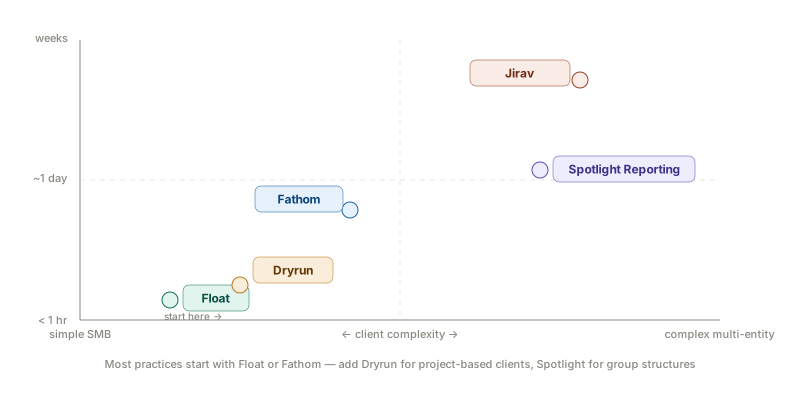
Fathom is the best all-round platform for practices managing multiple advisory clients — three-way forecasting, unlimited scenarios, up to 300 entities, and volume pricing designed for accountants. Float is the fastest entry point for practices starting with a single client on Xero or QBO — deploys in under an hour, produces a usable 13-week forecast immediately. Dryrun is the best choice for clients with variable or project-based revenue where scenario flexibility matters more than automated data pull. Spotlight Reporting is the strongest multi-entity platform for practices managing complex group structures across multiple jurisdictions. Jirav is the right tool for mid-market clients where FP&A depth and board-ready outputs justify the higher price point.
Side-by-Side Comparison
| Tool | Best for | Three-way | Forecast horizon | Multi-entity | Price from | Free trial |
|---|---|---|---|---|---|---|
| Fathom | Multi-client advisory practices | ✓ | Monthly | Up to 300 entities | $59/mo per company | 14 days |
| Float | SMB, Xero / QBO / FreeAgent | ✗ | 13-week rolling | Single entity | ~$59/mo per company | 14 days |
| Dryrun | Variable / project-based revenue | ✗ | Weekly (manual) | Limited | $49/mo | 14 days |
| Spotlight Reporting | Complex group structures | ✓ | Monthly | Full consolidation | Custom (quote) | ✓ |
| Jirav | Mid-market, board reporting | ✓ | Monthly + drivers | Multi-source (ERP, HR, CRM) | ~$12K/yr | Demo only |
The Advisory Case Before the Tools
Before reviewing the platforms, I want to make the business case explicit — because the tool selection is secondary to the question of whether to build the service at all.
Cash flow is the most common cause of SMB failure. Research from PYMNTS puts 82% of small business closures down to cash flow management problems — most of which were visible in the data weeks or months before they became fatal. The businesses that close are not always the ones with poor fundamentals. They are often the ones where nobody was looking at the right numbers at the right time.
Your clients’ accounting data contains the inputs to predict these situations. The AR ageing, the creditor terms, the seasonality in their revenue — all of this is sitting in their Xero or QBO file, already coded and categorised. What it lacks is a model that projects forward and a professional who translates the model into a recommendation.
That is the gap cash flow advisory fills. And in 2026, with Basis demonstrating autonomous tax return preparation and Xero JAX handling reconciliation, the professional who fills that gap has a more defensible value proposition than the one who competes with software on transaction volume.
1. Fathom — Best for Multi-Client Advisory Practices
Fathom is the tool I reach for first when setting up cash flow advisory for a practice that already has 10+ clients on Xero or QBO. It is trusted by over 99,000 businesses globally, designed specifically for accountants and advisory firms, and the volume pricing structure is the most favourable of any platform on this list for multi-client deployments.
The core product is a three-way forecast: P&L, balance sheet, and cash flow statement linked in a single model that stays internally consistent as assumptions change. This is the structural difference between Fathom and simpler tools like Float — when a client’s debtor days lengthen or a large capital expense lands, Fathom’s model updates all three statements simultaneously. The cash flow number reflects reality, not an approximation.
Pricing
Fathom charges per company (client entity), not per user. Pricing starts at approximately $59 per month for a single company. Volume discounts apply for accounting firms managing multiple clients — the more clients you add, the lower the per-entity rate. Practices with 20+ advisory clients will find the blended per-client rate significantly below the headline figure. A 14-day free trial is available.
For practices building an advisory service from scratch, the economics work as follows: at $59 per client per month, you need to charge approximately £100–120 per client per month to cover the tool cost and generate a positive contribution margin. At £200–400 per client per month — a realistic rate for meaningful advisory engagement — the margin is substantial.
What Works Well
Three-way forecasting integrity is Fathom’s technical differentiator. When I set up Fathom for a UK manufacturing client alongside their accountant, the first output we produced showed that their projected revenue growth in Q3 would generate a cash shortfall in Q4 — because the receivables build-up from growth would not convert to cash until after the creditor payment cycle peaked. That insight was not visible in their P&L forecast or their bank balance trajectory separately. It was only visible in the three-way model. The accountant used it to recommend a £40,000 invoice finance facility before the client needed it, rather than after. That is the value cash flow advisory delivers.
Scenario planning is unlimited and linked. Fathom allows you to create best-case, base-case, and worst-case forecasts, plus unlimited custom scenarios for specific decisions — what if the client delays a hire by three months? What if their largest customer pays 30 days late? Each scenario updates the three-way model simultaneously and can be presented in a single comparison view. For client meetings, this turns a conversation about numbers into a conversation about decisions.
Client-ready reporting is genuinely polished. Fathom’s reports are branded, visual, and designed to be handed directly to a business owner rather than requiring an accountant to translate them. Commentary Writer (launched early 2026) generates written narrative for management reports based on the financial data and charts, which reduces report preparation time materially — the accountant edits and contextualises rather than writing from scratch.
Multi-entity consolidation handles up to 300 entities with multi-currency support, intercompany eliminations, and custom charts of accounts. For practices managing group structures — a holding company with operating subsidiaries, or a client with UK and US entities — this is production-grade functionality rather than a workaround.
What Does Not Work Well
Fathom’s forecasting horizon is monthly, not weekly or daily. For clients with tight liquidity — construction firms waiting on large milestone payments, retailers with seasonal inventory cycles — a monthly forecast misses the intra-month cash timing that determines whether a payroll cycle or a VAT payment can be met. Float handles this with 13-week weekly forecasting; Fathom does not.
Data quality dependency. Fathom’s three-way model is only as accurate as the coding quality in the underlying accounting file. If a client’s Xero has inconsistent creditor terms, incorrect accrual timing, or mixed revenue categories, the model reflects those errors. For practices taking on new advisory clients with messy books, the cleanup work comes before the forecasting value.
Pricing is per entity, not per seat. For a practice offering advisory to clients with multiple operating entities, the cost compounds quickly. A client with 3 entities costs 3x the per-company rate. Verify the entity count before quoting an advisory fee.
Fathom Pros and Cons
Pros:
- Three-way forecast integrity — P&L, balance sheet, and cash flow linked in one model
- Unlimited scenario planning, all linked to the main forecast
- Volume pricing designed for multi-client practices — economics improve at scale
- Commentary Writer generates narrative for management reports, saving drafting time
- Multi-entity consolidation up to 300 entities with multi-currency
- 99,000+ businesses using it — the most widely validated advisory platform on this list
Cons:
- Monthly forecast granularity — not suitable for tight-liquidity clients needing weekly cash visibility
- Three-way model quality depends on the underlying accounting data being clean and correctly coded
- Per-entity pricing compounds for clients with multiple operating entities
The strongest all-round platform for CPA firms building a multi-client cash flow advisory service — three-way forecasting, unlimited scenarios, Commentary Writer narrative generation, and volume pricing that improves as your advisory book grows.
2. Float — Best Entry-Level for Xero and QBO Practices
Float is the lowest-friction way to add cash flow visibility to an existing client relationship. It connects to Xero, QuickBooks Online, and FreeAgent, imports live transaction data, and produces a rolling 13-week cash flow forecast in under an hour of setup. For a practice that has never offered cash flow advisory but wants to start with one or two clients, Float is the right starting point.
The model Float produces is a direct cash flow forecast — not a three-way model. It shows weekly cash inflows and outflows projected forward from current bank balances, unpaid invoices, outstanding bills, and recurring transactions. For most SMB clients, this is more immediately useful than a three-way model, because it answers the question a business owner actually asks: “Will I have enough money in my account to pay staff and suppliers next month?”
Pricing
Float charges per company at approximately $59–79 per month depending on plan. It also offers an accountant programme with multi-client dashboard access and consolidated management across client portfolios. A 14-day free trial is available.
What Works Well
Setup is genuinely fast. When I have onboarded a new advisory client on Float with a clean Xero file, the initial forecast is ready to present within the same session. Float imports unpaid invoices and outstanding bills directly from Xero, maps them to their expected payment dates, and produces a weekly cash flow view from day one. The only manual input is categorising regular transactions that Xero does not have explicit payment terms for.
13-week rolling forecast is the sweet spot for SMB cash management. Short enough to be reliable (the further out you forecast, the more assumption-dependent the numbers), long enough to identify a gap three months out before it becomes an emergency. For a client approaching a VAT payment quarter, a seasonal revenue trough, or a lease renewal, 13 weeks of forward visibility is exactly the right horizon.
Scenario planning for specific decisions is simple and effective. Float’s scenario builder allows you to add a one-time item (a large client payment expected in Week 6), adjust a recurring item (reduce the weekly payroll assumption if headcount changes), or remove a line (if a planned capex is being deferred). The impact on the forecast line updates immediately. For client meetings, this produces a live modelling experience rather than a static presentation.
FreeAgent integration makes Float the only tool on this list that works for the UK sole trader and freelancer clients who are entering MTD ITSA. For practices with a portfolio of freelance and contractor clients, adding Float to those relationships means every MTD-compliant client also has a cash flow forecast — positioning the practice as advisory-forward rather than compliance-only.
What Does Not Work Well
No three-way forecasting. Float does not produce a linked P&L or balance sheet. For clients who need to present to a bank, investor, or board, Float’s output is not sufficient — you need Fathom or Jirav for those scenarios.
Limited multi-entity support. Float works well for single-entity SMB clients. For clients with group structures, intercompany transactions, or foreign currency subsidiaries, Float does not have the consolidation capability to produce a useful group forecast.
AI features are limited. Float incorporates basic machine learning for anomaly detection, but the AI layer is light compared to Fathom’s scenario linking or Jirav’s driver-based modelling. Float’s value is speed and simplicity, not AI sophistication.
Float Pros and Cons
Pros:
- Under one hour to a working forecast for any Xero or QBO client
- 13-week rolling direct cash flow — the most actionable horizon for SMB cash management
- FreeAgent integration — unique on this list, relevant for UK sole trader portfolios
- Simple scenario builder for live client meeting modelling
- Lowest barrier-to-entry advisory tool on this list
Cons:
- No three-way forecasting — not suitable for bank or investor presentation requirements
- Limited multi-entity support
- AI features are basic — trend detection, not predictive modelling
The fastest path from zero to a working client cash flow forecast — Xero, QBO, or FreeAgent integration, 13-week rolling view, and a live scenario builder make it the ideal first advisory tool for practices starting their cash flow offering.
3. Dryrun — Best for Variable and Project-Based Revenue
Dryrun is built for clients whose revenue does not arrive in predictable monthly instalments. Construction firms billing against project milestones. Marketing agencies with retainer plus project revenue. Consulting practices with variable client engagement lengths. For these businesses, a forecast tool that simply extrapolates historical averages produces a meaningless number. What they need is a model where you can manually specify when each project payment will arrive, and see how the combination of all active projects affects the cash position week by week.
That is what Dryrun does. It is more manual than Float — you are constructing revenue scenarios from the ground up rather than importing an existing invoice list — but for the right client type, that control is exactly what produces a useful forecast.
Pricing
Dryrun charges approximately $49 per month for the Solo plan and $99 for teams, with unlimited scenario planning on all plans. A 14-day free trial is available.
What Works Well
Unlimited scenario modelling with confidence intervals. Dryrun’s AI layer analyses historical payment patterns and provides confidence bands around each scenario — this project typically pays in 45 days, here is the range of outcomes if it pays in 30 or 60. For an advisor presenting three scenarios to a client, each with a probability-weighted cash outcome, this is more defensible than presenting three scenarios with identical certainty.
Project milestone forecasting is the feature that has no direct equivalent in Float or Fathom. You define a project, specify its payment milestones and expected dates, and Dryrun slots each milestone into the weekly cash flow. When you have 12 active projects and 6 in the pipeline, the combined forecast shows the client’s true cash trajectory rather than a line that assumes historical average revenue continues indefinitely.
Multi-scenario comparison on a single screen makes client conversations efficient. Rather than switching between tabs or presenting multiple PDFs, Dryrun shows best, base, and worst case on the same cash flow chart, colour-coded with a clear break-even visibility line. I have found this format the most effective for clients who are not financially trained — the message “here is the line where you run out of cash in the worst case, here is what you need to do to prevent it” is legible in 30 seconds.
What Does Not Work Well
No three-way forecasting. Like Float, Dryrun does not produce a linked balance sheet or P&L. It is a cash flow planning tool, not a full financial model.
Manual data entry for project revenue. Dryrun pulls historical transactions from your accounting software but requires you to manually input project milestones and expected payment dates. For a client with 20+ active projects, maintaining this in Dryrun requires a regular update cadence — typically 30–45 minutes per month per client to keep the pipeline current. That time investment needs to be priced into the advisory fee.
No AP automation or AR collections. Dryrun does not help execute on the forecast recommendations — it does not chase invoices, process payments, or integrate with collections workflows. It is a planning tool only.
Dryrun Pros and Cons
Pros:
- Best scenario modelling for variable/project-based revenue — unlimited scenarios with confidence intervals
- Project milestone forecasting has no equivalent in Float or Fathom
- Multi-scenario single-screen comparison is the clearest client presentation format on this list
- Affordable entry price with unlimited scenarios from the lowest tier
Cons:
- No three-way forecasting
- Project pipeline requires manual maintenance — ongoing time investment per client
- Not suitable for clients with stable, predictable recurring revenue where simpler tools suffice
The best forecasting tool for clients whose revenue is tied to project milestones — construction, agencies, consulting — where scenario confidence intervals and manual project pipeline management produce a genuinely useful cash forecast.
4. Spotlight Reporting — Best for Multi-Entity Group Structures
Spotlight Reporting is a modular platform for reporting, forecasting, and consolidation, used predominantly by accounting firms in the UK, Australia, New Zealand, South Africa, and North America. Its distinguishing capability is multi-entity consolidation with currency conversion, intercompany elimination, and group-level cash flow forecasting — the features that matter when a client has more than one operating entity.
For practices with a portfolio that includes any holding company structures, franchises, or international subsidiaries, Spotlight is the tool that handles the consolidation layer that Float and Dryrun cannot.
Pricing
Spotlight uses a modular pricing model — reporting, forecasting, and consolidation are available separately or bundled. Pricing is not published publicly; practices request a quote based on client volume and module selection. A free trial is available.
What Works Well
Consolidated group forecasting is Spotlight’s headline capability. A holding company with three trading subsidiaries in different currencies gets a single consolidated cash flow forecast with intercompany transactions eliminated, currency converted at current or budget rates, and group-level variance reporting. This is production-grade group consolidation at an accounting firm price point — not enterprise treasury software pricing.
Strong UK and Xero ecosystem integration makes Spotlight a natural fit for UK practices. The platform integrates deeply with Xero’s data model, and the UK accountant community has extensive Spotlight expertise — training resources, community forums, and peer practice examples are readily available.
ESG reporting via Spotlight Sustain is an emerging differentiator for practices serving clients with sustainability reporting requirements. While this is not a forecasting feature per se, the addition of ESG data alongside financial forecasting within one platform positions Spotlight well for the compliance direction that mid-market UK and EU businesses are heading.
What Does Not Work Well
Interface complexity is the most consistent criticism in user reviews. Spotlight’s modular structure means more configuration decisions upfront, and the workflow between reporting, forecasting, and consolidation modules is not as seamless as Fathom’s all-in-one approach. For practices starting with cash flow advisory for the first time, Spotlight’s learning curve is steeper than Float or Fathom.
Pricing opacity makes it harder to calculate ROI before committing. Unlike Float ($59/month) or Fathom ($59/company), Spotlight requires a quote, which means the sales process is longer before you can assess whether the economics work for your practice.
Spotlight Pros and Cons
Pros:
- Best multi-entity group consolidation of any tool on this list
- Strong UK and Xero ecosystem integration and community
- ESG reporting alongside financial forecasting — positioned for regulatory direction of travel
- Widely used by UK and ANZ practices — strong peer knowledge base
Cons:
- Interface complexity — steeper learning curve than Float or Fathom
- Opaque pricing — requires sales engagement before ROI assessment
- Less suitable for simple single-entity SMB advisory where Fathom or Float are more efficient
The strongest choice for UK and ANZ practices with group structure clients — consolidated forecasting with intercompany elimination, multi-currency, and Xero-native integration at accounting firm pricing.
5. Jirav — Best for Mid-Market FP&A Depth
Jirav is a cloud-based financial planning platform built for mid-market companies with $5M–$100M in revenue — typically the upper end of what a CPA advisory practice serves, and often the client segment where advisory engagements are highest-value. Its strength is driver-based financial modelling: the ability to connect revenue projections directly to headcount, operating costs, and cash flow through a model that updates automatically when business assumptions change.
For a practice advising a 50-person technology company approaching its Series B, or a professional services firm planning a geographic expansion, Jirav produces the board-ready outputs that a founding CEO can present to investors — not a bookkeeper’s cash flow summary.
Pricing
Jirav uses custom pricing based on company size and module selection. Research suggests baseline pricing starts in the $12,000–$24,000 per year range for mid-market deployments. This positions it firmly as a tool for high-value advisory relationships rather than the SMB advisory market served by Float and Fathom.
What Works Well
Driver-based modelling is the feature that separates Jirav from every other tool on this list. Instead of manually adjusting a line item when a client plans to hire five engineers, you change the headcount driver and Jirav automatically cascades the impact through payroll, benefits, office costs, software licences, and ultimately cash flow. For clients planning significant growth or restructuring, this produces a model where the interconnections between business decisions and financial outcomes are explicit and updateable in real time.
Board-ready reporting is Jirav’s strongest presentational output. Reports export in formats designed for investor decks and board packs, with the kind of visual clarity that distinguishes an FP&A output from an accounting report. For practices positioning themselves as CFO-light advisory for growth businesses, Jirav’s reporting quality supports that positioning.
QuickBooks, Xero, NetSuite, and HRIS integrations mean Jirav can pull actuals from the client’s accounting system, headcount from their HR software, and pipeline from their CRM simultaneously. The forecast is built on a multi-source data model rather than accounting data alone — which is more accurate for businesses where non-financial drivers (sales pipeline, hiring plans, churn rate) determine the financial trajectory.
What Does Not Work Well
Price point excludes most SMB advisory relationships. At $12,000–$24,000+ per year, Jirav only makes economic sense for high-value advisory relationships where the client is paying the accountant £1,000–3,000 per month for advisory services. For a standard SMB advisory engagement at £200–400 per month, Jirav’s tool cost exceeds the revenue.
Implementation is longer than other tools on this list. Setting up Jirav’s driver-based models correctly for a specific client’s business requires 1–2 weeks of initial configuration. This is not a one-hour setup like Float.
Jirav Pros and Cons
Pros:
- Driver-based modelling connects business decisions to financial outcomes automatically
- Board-ready reporting suitable for investor presentations and CFO-level deliverables
- Multi-source data integration — accounting, HR, and CRM in one model
Cons:
- Price point ($12K–$24K+/year) only justified for high-value mid-market advisory relationships
- 1–2 week implementation — not suitable for rapid client onboarding
- Overpowered for typical SMB advisory relationships
The right tool for CPA practices serving growth-stage or mid-market clients where driver-based modelling and board-ready reporting justify the premium — most powerful FP&A advisory platform on this list for the right client segment.
Which Tool Fits Which Advisory Practice?
Just starting with cash flow advisory (first 1–5 clients): Start with Float. The economics are clear, the setup is fast, and the 13-week direct cash flow forecast answers the question most SMB clients are actually asking. Once you have the workflow, pricing model, and client communication sorted, migrate to Fathom for the three-way capability.
Building a multi-client advisory practice (6–30 clients): Fathom, for its volume pricing, three-way forecasting, and Commentary Writer. The all-in-one model means you are not learning a new tool as you add clients.
Serving construction, agency, or project-based clients: Dryrun alongside whichever platform you use for your other clients. The project milestone forecasting capability is specific enough that it is worth the dual-platform overhead.
Managing complex group structures: Spotlight Reporting for any client with more than one entity. Fathom for single entities within the same portfolio.
CPA-as-CFO for growth-stage and mid-market companies: Jirav — but only for relationships where the advisory fee reflects the engagement depth the tool requires.
A Note on Pricing Your Advisory Service
The most common mistake I see CPA firms make when adding cash flow advisory is underpricing it. They add the tool subscription to their cost base and charge a flat fee that covers the software cost plus one hour of their time — and then wonder why it is not profitable.
Cash flow advisory is not a one-hour-per-month service. Done properly, it includes: reviewing the prior month’s actuals and updating the model, preparing scenario commentary, running the client meeting, and answering the questions that come out of the meeting. For a client with any complexity, that is 3–5 hours of work per month.
Price accordingly. The tools in this list range from $49 to $24,000+ per year. The professional time is worth multiples of that. The practices generating real revenue from cash flow advisory are charging £250–600 per month for SMB clients and £800–2,000 for mid-market clients — because the value delivered justifies it, and the clients who understand their cash flow are the ones who grow and stay.
What This Means for the Future of CPA Firms
The Basis funding story from Q1 2026 — an AI agent that completes a Form 1065 tax return autonomously — is the direction of travel for compliance work. It is not arriving everywhere simultaneously, and it will not replace the full scope of CPA services in the next three years. But it is arriving.
The practices I see positioning themselves well are not waiting for that to happen to their compliance revenue before building something new. They are using the time AI is freeing from low-value data processing to build advisory relationships that generate higher per-client revenue, higher client retention, and a business model that is genuinely complementary to AI rather than competing with it.
Cash flow forecasting is where most of them start. It is the most tangible advisory output, the easiest to price, and the one where clients most clearly understand the value before they receive it. The tools are good enough. The question is whether the practice invests the time to build the service.
Prices and features verified from multiple sources as of April 2026 — verify directly with each vendor before purchase. All pricing quoted per company entity unless otherwise stated.
This is not financial advice. Last reviewed: April 2026.