

Best AI Agents for Accounting Firms in 2026: What Actually Works
There is a critical distinction buried in almost every article about AI agents for accountants, and most articles do not make it explicitly. The distinction is this: there are AI agents for your practice — tools that automate the internal workflows of running a CPA firm — and there are AI agents for your clients — tools you recommend or deploy to automate your clients’ bookkeeping, AP, and financial workflows.
These are different products, different buying decisions, and different risk profiles. Karbon AI Agents automates your firm’s follow-up sequences and onboarding workflows. Basis automates your accountants’ preparation work. Pilot AI Accountant autonomously books your client’s transactions. They are all AI agents — but deploying the wrong one in the wrong context is how firms end up with automation that creates more oversight work than it saves.
This guide covers both categories. For each tool, I have been explicit about which problem it solves and for whom.
One context point that matters: we have reached a tipping point where those not investing in AI risk being left behind — accounting firms are reengineering workflows, retraining staff, and fundamentally changing service delivery models around AI. A January 2026 Deloitte study found that 63% of finance organisations have fully deployed AI in their operations, and nearly 50% of CFOs report having fully integrated AI-driven agents into parts of the finance function.
Quick Verdict
Basis is the most capable AI agent platform built specifically for CPA firms — handles CAS, tax preparation, and audit workflows end-to-end, used by 30% of the top 25 US accounting firms. Karbon AI Agents is the right starting point for most practices — operates within your existing workflow platform, handles repetitive coordination tasks autonomously. BILL AI Agents is the most accessible entry point for client-facing AP automation — W-9 collection and reconciliation agents that smaller firms can deploy without enterprise contracts. Pilot AI Accountant is the most advanced autonomous bookkeeping agent for SMB clients — the first credible demonstration of zero-human-intervention bookkeeping. Intuit Assist / QBO AI agent suite is the ambient layer already inside the platform most of your clients use.
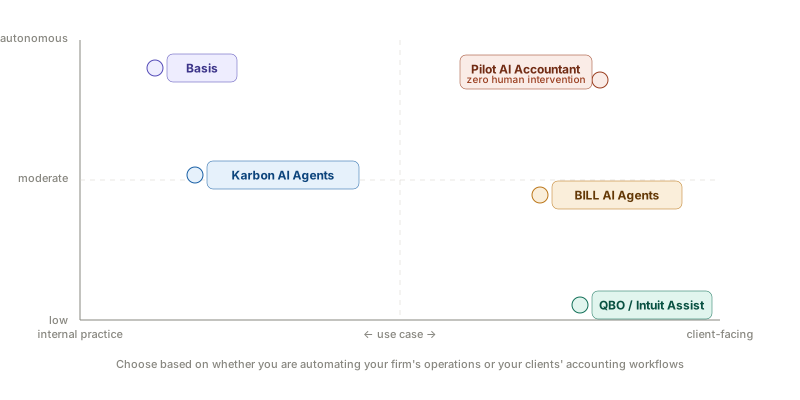
Side-by-Side Comparison
| Agent | Use case | Autonomy level | Best for | Price |
|---|---|---|---|---|
| Basis | Tax, CAS, Audit prep | High — end-to-end workflows | Mid-large CPA firms | Custom enterprise |
| Karbon AI Agents | Practice follow-up, onboarding | Moderate — within Karbon | All firm sizes | Included in Karbon |
| BILL AI Agents | AP automation, W-9, reconciliation | Moderate — client AP workflows | Firms managing client AP | From $45/user/mo |
| Pilot AI Accountant | SMB bookkeeping | High — zero human intervention | US startup clients | Custom |
| QBO / Intuit Assist | Invoicing, categorisation, follow-up | Low-moderate — prompted | Clients on QBO | Included |
The Two Categories — Why the Distinction Matters
Before the tools: the framework. Mixing these categories is the most common mistake I see when CPA firms evaluate AI agents.
Category A: Agents for your practice
These run inside your firm’s operations. They automate workflows your team currently does manually — client follow-ups, document requests, task routing, data entry into your practice management system, first-pass preparation work on client engagements. Your team remains the professional responsible for the output. The agent reduces the hours your team spends on mechanical execution.
Basis and Karbon AI Agents sit here. The client never interacts with these agents directly — they interact with your team, which is now more efficient because agents handle the groundwork.
Category B: Agents for your clients
These run inside your clients’ operations. They automate your clients’ accounting workflows — bookkeeping, AP processing, bank reconciliation, expense coding. You recommend or deploy them as part of your tech stack advisory. The client’s business is the beneficiary. Your role shifts from doing the bookkeeping to reviewing and advising on AI-produced output.
Pilot AI Accountant, BILL agents, and QBO’s AI agent suite sit here. This is also where the professional responsibility question is most acute — when an AI agent books your client’s transactions and you review them monthly, your firm’s oversight procedure needs to be documented.
1. Basis — Best for Mid-to-Large CPA Firms
Basis is the AI agent platform built specifically for accounting firm workflows. It raised $100 million in Series B funding in February 2026 at a $1.15 billion valuation, and is currently used by 30% of the top 25 US accounting firms across CAS, tax preparation, and audit engagements.
Basis runs in the background, executing accounting workflows end-to-end and updating you at key stages. Finished output is delivered ready for review, at the level of quality you’d expect from an experienced accountant. The design philosophy is explicit: doers become reviewers. When Basis handles execution, your accountants shift from preparing work to reviewing it.
What Basis Actually Does
The capability that made Basis notable in early 2026: it was the first AI system to autonomously complete a Form 1065 partnership return end-to-end. The demonstration involved a real partnership return — one of the most complex US tax filings — completed without human preparation. The partner reviewed the output and signed it.
That single demonstration changed the conversation about AI agents in accounting more than any feature announcement from the legacy vendors. It moved agentic tax preparation from theoretical to operational.
Beyond the 1065 demonstration, Basis operates across three practice areas. For CAS engagements, agents handle transaction coding, reconciliation, financial statement preparation, and variance commentary. For tax, agents handle data extraction from source documents, form population, supporting schedule preparation, and the coordination between multiple tax forms. For audit, agents handle documentation assembly, tick-and-tie procedures, and workpaper organisation.
What Works Well
Designed for CPA firm workflows, not adapted from SMB tools. Basis was built by people who understand how CPA firms actually work — engagement structures, review hierarchies, partner sign-off requirements. The workflow conforms to how your firm operates, not the other way around.
Scales across practice areas. A firm can deploy Basis on CAS engagements first, learn the oversight workflow, then expand to tax — without switching platforms. This matters because the learning curve for AI agent oversight is real, and building it in one practice area before rolling to others reduces implementation risk.
The review workflow is built in. Basis does not produce outputs and then expect you to build your own review process. The platform is designed around the CPA’s review step — outputs are staged for partner review, with the agent’s reasoning visible alongside the work product.
What Does Not Work Well
Enterprise pricing and sales process. Basis does not publish pricing. Engaging with it requires a demo and proposal. For firms below a certain revenue threshold, the pricing may not be recoverable through efficiency gains.
Requires a redesigned workflow, not just an add-on. Firms that deploy Basis expecting it to fit into existing workflows without change are the ones that see limited ROI. The firms that benefit most have explicitly redesigned their review and quality-control procedures around AI-produced outputs.
Basis Pros and Cons
Pros:
- First AI system to autonomously complete a Form 1065 — production-grade tax capability
- Designed specifically for CPA firm engagement structures
- Covers CAS, Tax, and Audit in one platform
- Used by 30% of top 25 US accounting firms — the most validated option in this list
- Built-in review workflow — not a black box
Cons:
- Enterprise pricing — not accessible for smaller practices
- Requires workflow redesign, not plug-and-play
- US-focused — not the right choice for UK or Canadian practices
The most capable AI agent platform built specifically for CPA firm workflows — CAS, tax, and audit covered in one system, with the first demonstrated autonomous 1065 completion and use by 30% of the top 25 US accounting firms.
2. Karbon AI Agents — Best for Internal Practice Automation
Karbon AI Agents is the version of AI agents most immediately accessible to practices of any size. Karbon is the leading practice management platform for accounting firms — used by 30,000+ accounting professionals — and its AI Agents layer operates inside the platform your team already uses daily.
Where Basis automates the accounting work your team does on client engagements, Karbon AI Agents automates the coordination work your team does to manage the practice — client follow-ups, task creation, onboarding sequences, data entry, and the repetitive procedural steps that occupy 20-30% of every accountant’s week without producing billable output.
What Karbon AI Agents Does
Karbon AI Agents handles three categories of task. First, client communication automation: when a client has not responded to a document request, the agent sends a follow-up at the configured interval without anyone on your team doing it manually. Second, onboarding sequences: when a new client is added, the agent initiates the onboarding workflow — welcome communication, document request, engagement letter routing — autonomously. Third, data entry and task creation: when an email arrives with a client query, the agent creates a task in the relevant job file and routes it to the appropriate team member.
None of these are the high-autonomy, end-to-end workflow completion that Basis delivers. They are the medium-autonomy, process-step automation that eliminates the coordination overhead that accumulates invisibly across a practice’s operations.
What Works Well
Included in existing Karbon subscriptions during open beta. This makes Karbon AI Agents the only tool on this list that a practice can deploy today at zero marginal cost. The beta designation means a pricing tier will arrive in future — get clarity on timing before building critical workflows around it.
No workflow redesign required. Karbon AI Agents operates within the workflow structures you have already built in Karbon. If your pipelines and templates are configured, the agents use them. This is the opposite of Basis — it reduces implementation friction to nearly zero for teams already on Karbon.
Immediate visibility into what agents are doing. Karbon’s activity log makes every agent action visible — what it did, when, and why. For practices concerned about AI operating without oversight, this transparency is a meaningful differentiator from more opaque automation tools.
What Does Not Work Well
Moderate autonomy ceiling. Karbon AI Agents automates discrete tasks within a workflow. It does not execute end-to-end complex workflows the way Basis does. A client follow-up sequence runs autonomously; an engagement’s tax preparation does not.
Future pricing unknown. Karbon has confirmed AI Agents will eventually be a paid tier. For practices building dependent workflows, the unknown future cost is a planning risk.
For a deeper look at Karbon’s full feature set including email AI and workflow management: see our TaxDome vs Karbon comparison in the Best AI Tools for Accountants roundup.
Karbon AI Agents Pros and Cons
Pros:
- Included in Karbon subscriptions during open beta — zero marginal cost now
- Operates within existing Karbon workflow structures — no redesign required
- Full activity log — every agent action visible and auditable
- Appropriate for practices of all sizes, not just enterprise
Cons:
- Moderate autonomy — task-level automation, not end-to-end workflow completion
- Future pricing not yet defined
- Requires Karbon — not useful if you are on TaxDome or another platform
The most accessible AI agent entry point for any practice already on Karbon — automates client follow-ups, onboarding sequences, and task creation within your existing workflow structure at zero marginal cost during beta.
3. BILL AI Agents — Best for Client AP Automation
BILL is the AP and AR automation platform used by 3+ million businesses. Its recent AI agent expansion moves it firmly into agentic territory: the W-9 Agent and Reconciliation Agent handle multi-step workflows autonomously within a client’s AP process.
BILL’s AI-powered W-9 Agent autonomously collects and validates vendor tax forms, which BILL claims eliminates over 80% of manual steps in the W-9 collection process. Its Reconciliation Agent automatically codes expense receipt transactions so they reconcile themselves. In early rollout, the share of transactions fully processed by AI increased by 533% with approximately 92% accuracy.
For CPA firms managing AP workflows for clients, BILL AI Agents is the most accessible entry point into client-facing agentic automation — accessible without the enterprise contracts that Basis requires, and with the QBO and Xero integrations that make deployment into existing client stacks straightforward.
What Works Well
W-9 collection is a genuine pain point solved autonomously. Every CPA firm that manages client vendor relationships knows the W-9 collection problem: chasing vendors for tax forms before year-end, manually validating what comes back, following up on incomplete submissions. The W-9 Agent handles this end-to-end — sends, chases, validates, and logs — without anyone on your team initiating each step.
533% increase in AI-processed transactions in early rollout is a credible efficiency signal. 92% accuracy at that volume means the agent handles the routine majority; humans handle exceptions — which is the right division of labour for a production AP workflow.
Transparent pricing from $45/user/month makes the ROI calculation accessible for smaller firms managing client AP. Unlike Basis, BILL’s pricing is published and predictable.
What Does Not Work Well
AP-specific scope. BILL agents handle AP and AR automation. They do not touch bookkeeping, close management, tax preparation, or practice management. For practices needing broader automation, BILL is one layer in the stack, not the full solution.
For a detailed comparison of BILL against Stampli and Vic.ai for more complex AP workflows: see our Vic.ai Alternatives guide.
W-9 collection and reconciliation agents that handle the most time-consuming AP coordination tasks autonomously — 80%+ manual steps eliminated on W-9 workflows, 533% increase in AI-processed transactions in early rollout.
4. Pilot AI Accountant — Best Autonomous Bookkeeping Agent for Clients
In February 2026, Pilot announced what it calls the world’s first fully autonomous AI Accountant for SMBs, which runs the entire bookkeeping process from onboarding through monthly close with zero human intervention.
Pilot’s AI Accountant sits firmly in Category B — it is an agent you recommend to clients whose bookkeeping you currently manage, allowing you to shift your role from bookkeeper to reviewer. For practices with significant bookkeeping revenue from SMB clients on modern fintech stacks, this is the most significant product development of 2026.
The capability is real: Pilot’s AI handles transaction categorisation, bank reconciliation, accrual entries, and monthly close without human initiation at each step. The CPA firm reviews the output. This is the continuous close model we covered in our AI month-end close guide — operationalised into a client-facing agent.
The partner model matters. Pilot has explicitly committed to never competing with CPA firms for client relationships — its partner model is built around accounting firms, not around displacing them. This is a commercial differentiator from QuickBooks Live and Digits, which do compete for bookkeeping clients directly.
Pros and Cons
Pros:
- First fully autonomous SMB bookkeeping agent — zero human intervention from onboarding to close
- Partner-only model — does not compete with your firm for client revenue
- Shifts your role from bookkeeper to reviewer — expands capacity without adding headcount
Cons:
- US-only — not available for UK or Canadian clients
- Modern fintech stack required — clients on traditional banking without live API feeds see limited benefit
- Zero-intervention claim requires CPA review layer — not a substitute for monthly oversight
The most advanced autonomous bookkeeping agent for US SMB clients on modern fintech stacks — runs onboarding through monthly close with zero human intervention, partner model that never competes with your firm.
5. Intuit Assist and QBO AI Agent Suite — The Ambient Layer
Intuit’s AI agent suite is not a single product you buy — it is the AI layer built into QuickBooks Online that your clients are already using. In mid-2025, Intuit launched what it described as a virtual team of AI agents for QBO: agents that create and send invoices, track and reconcile transactions, categorise expenses, and follow up on unpaid bills without manual initiation.
The practical significance for CPA firms: a large portion of your existing clients are already using AI agents without knowing it. QBO’s expense categorisation, invoice chasing, and bank reconciliation suggestions are all agent-driven in 2026. Your role in the client relationship is already shifting whether or not you have explicitly chosen to deploy AI agents.
This ambient AI layer is lower autonomy than Basis or Pilot — it executes discrete tasks and requires more human initiation than true end-to-end agents. But its ubiquity matters: it is the first layer of agentic automation for the majority of small business clients in the US market.
Which Fits Which Practice?
Firms under 5 staff: Start with Karbon AI Agents for internal automation and BILL agents for any clients where AP is a billable service. Zero additional cost on Karbon; predictable BILL pricing.
Firms 5–15 staff: Add Pilot AI Accountant for US SMB bookkeeping clients — shifts bookkeepers from doers to reviewers and expands capacity. Evaluate Basis if your tax practice has sufficient volume to justify the enterprise pricing.
Firms 15+ staff / Top 100 firms: Basis is designed for this scale. The 30% top-25 firm adoption rate is the reference point. Combine with Karbon AI Agents for internal operations and BILL for client AP.
UK practices: Basis and Pilot are US-focused. Karbon AI Agents works globally. For UK-specific bookkeeping automation, Xero JAX handles the ambient layer — see our UK HMRC accounting tools guide.
A Note on Professional Responsibility
This is the dimension that never appears in AI agent roundups, and it should appear in every one.
When an AI agent executes a workflow — codes a transaction, populates a tax form, sends a client communication — the professional responsibility for the output remains with the licensed CPA. AICPA guidance is consistent on this point: AI tools and agents are instruments of the practitioner, not substitutes for professional judgement.
The practical consequence: deploying AI agents requires documenting your oversight procedures. What did the agent do? What did your team review? What was the sign-off process? For tax agents like Basis, this is structured into the product. For more general agents like Karbon or BILL, your firm needs to build the oversight protocol explicitly.
The firms that are ahead in 2026 are not those that have automated the most — they are those that have built the oversight infrastructure to operate AI agents at scale while maintaining the professional standards their clients and regulators expect.
For the oversight and fraud detection layer that sits on top of all AI agent deployments, see our AI Fraud Detection for Accountants guide.
Pricing and features verified as of May 2026. Basis and Pilot use custom pricing — figures reflect market benchmarks, not published rates. Karbon AI Agents pricing will change when open beta ends — verify current terms before building dependent workflows.
This is not legal or professional compliance advice. Last reviewed: May 2026.