

5 Best AI Tools for UK Accountants in 2026 (MTD-Ready & HMRC-Compliant)
Most “best AI tools for accountants” roundups are written for the US market. They evaluate tools on sales tax handling, QuickBooks integration, and USD pricing. If you run a UK practice, that is not particularly useful.
UK accounting is a different discipline. VAT has five supply types — standard, reduced, zero-rated, exempt, and outside scope — not one flat rate. Making Tax Digital mandates API submissions to HMRC, not just digital record-keeping. Construction firms carry CIS obligations that many non-UK tools do not understand at all. And UK GDPR requires a data processing agreement before you feed client data into any third-party AI platform — including the tools that are free to use in other contexts.
I have spent the past two years setting up AI-augmented workflows for UK accounting practices of various sizes — from sole practitioners managing 15 freelance clients to eight-person firms with mixed limited company, sole trader, and landlord portfolios. The tools in this list are the ones that have held up in production, not just in demos.
The context driving every tool decision in 2026: MTD for Income Tax Self Assessment became mandatory from 6 April 2026 for sole traders and landlords with gross income over £50,000. That is not a future consideration — it is live now. Any tool you deploy for this client segment must produce quarterly submissions that pass HMRC’s API validation. That requirement eliminates a large proportion of what gets marketed as “AI accounting software” in the UK.
Quick Verdict
Xero is the best all-round platform for UK practices — MTD-certified, deepest integration ecosystem, and JAX AI handles bank reconciliation and invoice workflows with 80% automation rates. FreeAgent is the best value option for sole traders and freelancers, and genuinely free for clients banking with NatWest or RBS. Sage is the right call for payroll-heavy portfolios — payroll is built into every plan. QuickBooks UK is the most capable option for practices needing CIS and VAT bridge submissions in the same platform. Dext is the pre-accounting capture layer that makes all of the above work better — not an alternative to them.
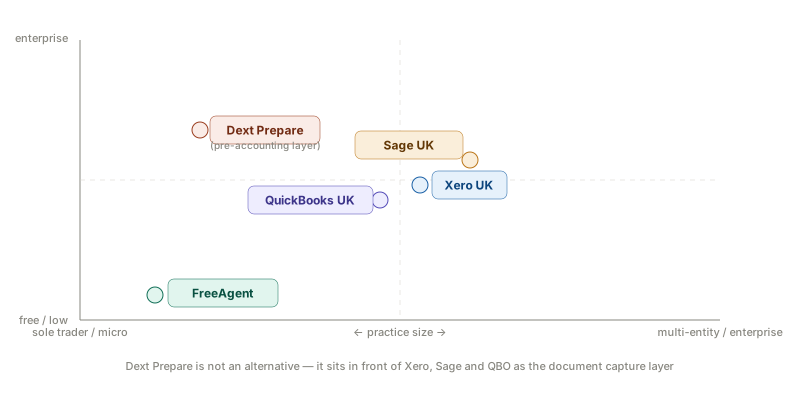
Side-by-Side Comparison
| Tool | MTD ITSA | UK VAT (5 types) | CIS | Payroll included | AI feature | Starting price |
|---|---|---|---|---|---|---|
| Xero UK | ✓ | ✓ all 5 types | ✓ | ✗ add-on | JAX AI superagent | £16/mo |
| FreeAgent | ✓ | ✓ | ✓ | ✓ | Smart Capture AI | £9.50/mo (or free) |
| Sage UK | ✓ | ✓ | ✓ | ✓ all plans | Sage Copilot | £16/mo |
| QuickBooks UK | ✓ | ✓ | ✓ VAT + CIS | ✓ add-on | AI categorisation | £16/mo |
| Dext Prepare | — capture only | ✓ UK codes | — | — | OCR + supplier rules | ~£208/mo practice |
1. Xero UK — Best for Growing Practices
Xero is the platform I recommend first to UK practices with more than five clients who are limited companies or VAT-registered sole traders. The combination of MTD certification, genuine UK VAT handling across all five supply types, and the September 2025 launch of JAX makes it the most capable AI-integrated accounting platform currently available in the UK market.
JAX — Just Ask Xero — is not a chatbot bolted onto a legacy platform. It is an agentic system built on Xero’s proprietary infrastructure that automates bank reconciliation, drafts invoice correspondence, and answers financial questions via mobile, desktop, WhatsApp, or email. Xero reports that JAX’s reconciliation predictions save mobile users 80% of the time previously spent on manual reconciliation. In practice on a 200-transaction account, that translates to a 35–45 minute weekly task becoming a 5-minute exception review.
Pricing
Xero UK plans start at £16 per month (excluding VAT) for the Ignite plan, rising to £37 for Grow, £50 for Comprehensive, and £65 for Ultimate. Payroll is not included in the base plans and costs extra per employee. A 30-day free trial is available.
Xero for accountants and bookkeepers is available through the Xero Partner Programme with discounted pricing for practices managing multiple client subscriptions. If you are setting up Xero for client accounts rather than your own practice, the partner programme pricing is substantially better than retail — apply directly through the Xero partner portal.
What Works Well
JAX bank reconciliation is the standout feature for UK practices in 2026. The AI learns from your corrections and improves over time. On well-established client accounts with consistent supplier patterns, JAX’s automatic reconciliation rate exceeds 85% — the remaining 15% are presented as suggested matches for one-click approval. For a practice handling 10 client accounts, this alone justifies the subscription cost.
UK VAT handling is complete and accurate. Xero correctly maps all five UK VAT supply types, handles reverse charge VAT for CIS transactions, and submits MTD VAT returns directly to HMRC via API. The VAT return screen is the cleanest in the market — exceptions are flagged before submission, not discovered during HMRC review.
Integration depth is unmatched in the UK market. Xero connects to 1,000+ apps including Dext, Hubdoc, Chaser, GoCardless, and the full suite of payroll tools. For practices building a multi-tool stack, Xero is typically the hub that everything else connects to.
MTD ITSA is fully supported for quarterly submissions and Final Declaration. Xero was one of the first platforms to receive HMRC certification for MTD ITSA, and the submission workflow is straightforward for both accountant and client.
What Does Not Work Well
Payroll is an add-on, not included. For a practice with payroll-heavy clients, this is a meaningful cost addition. Sage includes payroll on every plan. If payroll is a significant part of your client portfolio, the total cost comparison between Xero and Sage shifts materially once you add payroll subscriptions.
Support is frequently cited as slow. Xero Community Forum and Capterra reviews consistently mention that support responses are slow and often automated rather than substantive. For practices with urgent issues during self-assessment or quarter-end, this is a real operational risk. The partner programme does improve support access — another reason to register as a Xero partner if you are managing multiple clients.
JAX is still maturing. Some user reviews note that JAX’s conversational features are UK-functional but not yet at the fluency level Xero’s marketing suggests. Bank reconciliation automation is production-grade; the broader conversational AI features are still improving.
Xero UK Pros and Cons
Pros:
- JAX AI automates 80%+ of bank reconciliation on well-established accounts
- Complete UK VAT handling across all five supply types including reverse charge
- MTD VAT and MTD ITSA certified — direct API submission to HMRC
- Deepest UK integration ecosystem — 1,000+ apps
- Xero Partner Programme reduces cost for multi-client practices
Cons:
- Payroll not included — meaningful add-on cost for payroll-heavy clients
- Support response times frequently criticised by users
- JAX conversational features still maturing — reconciliation is excellent, broader AI less so
- Can be overcomplex for solo traders who need a simpler interface
JAX AI automates 80%+ of bank reconciliation, complete UK VAT handling, and MTD ITSA certified — the strongest all-round platform for UK practices managing mixed limited company and sole trader portfolios.
2. FreeAgent — Best for Sole Traders and Freelancers
FreeAgent is a UK-built platform, founded in Edinburgh in 2007 and acquired by NatWest Group in 2018. That banking group ownership gives it one capability no competitor matches: it is provided completely free to clients who hold a business current account with NatWest, Royal Bank of Scotland, or Ulster Bank.
For practices with a portfolio weighted towards freelancers, contractors, and landlords — the exact client segment that MTD ITSA catches first — FreeAgent is frequently the right answer before you have even opened a pricing comparison.
Pricing
FreeAgent charges £9.50 per month for sole traders and £19 per month for limited companies and landlords on its standard plans. As noted, it is free for NatWest, RBS, and Ulster Bank business customers. A 30-day free trial applies to paid plans.
The pricing model is per-entity, not per-user — your firm pays one subscription per client account. For practices managing many sole trader clients, this is significantly cheaper than Xero or Sage at scale.
What Works Well
The Tax Timeline is FreeAgent’s genuine differentiator for MTD ITSA clients. Throughout the tax year, FreeAgent models the client’s expected Self Assessment liability in real time based on income and expenses logged to date. As MTD quarterly submissions require year-round bookkeeping rather than a January scramble, this feature answers the question clients will ask most often: “How much do I owe HMRC and when?” Without any AI prompt or manual calculation, the client can see their estimated liability update as transactions are logged.
Smart Capture AI extracts data from receipts, invoices, and bank statements with high accuracy and publishes automatically to the ledger. For sole traders submitting receipts via mobile, this eliminates manual data entry almost entirely.
MTD ITSA is fully supported including quarterly submissions and Final Declaration. FreeAgent was one of the early platforms to receive HMRC certification and the compliance workflow is deliberately simple — built for clients who are not accountants, not for accountants managing a back-office system.
Free for NatWest and RBS business customers means a material portion of your UK sole trader and landlord clients may already be eligible. In my experience advising practices in the Midlands and South East, roughly a third of sole trader clients bank with NatWest Group, making this genuinely useful rather than a niche edge case.
What Does Not Work Well
FreeAgent is not built for complexity. Multi-currency is limited, advanced inventory management is not available, and the reporting suite is basic compared to Xero. For limited companies with complex VAT positions, overseas income, or multiple directors, FreeAgent quickly hits its ceiling.
Limited third-party integrations. FreeAgent connects to Dext and a handful of payroll tools, but the integration ecosystem is significantly narrower than Xero. Practices building a multi-tool stack typically use Xero as the hub, not FreeAgent.
Payroll is functional but not the primary strength. It handles RTI submissions correctly, but payroll-heavy practices will find Sage’s native payroll more capable and better supported.
FreeAgent Pros and Cons
Pros:
- Free for NatWest, RBS, and Ulster Bank business current account holders
- Tax Timeline shows real-time Self Assessment liability throughout the year
- Purpose-built for UK sole traders and freelancers — MTD ITSA native
- Simple interface suitable for clients managing their own bookkeeping
- £9.50/mo for sole traders — lowest priced paid platform on this list
Cons:
- Limited third-party integration ecosystem
- Not suitable for complex limited company structures or multi-currency
- Reporting is basic compared to Xero or Sage
- Partner programme is less developed than Xero’s for multi-client practices
The Tax Timeline feature is uniquely suited to MTD ITSA — sole trader clients see their real-time HMRC liability update throughout the year, eliminating the January surprise. Free for NatWest and RBS customers.
3. Sage UK — Best for Payroll-Heavy Portfolios
Sage is the UK market veteran — it has been serving British businesses since 1981 and holds the largest share of the UK mid-market accounting software segment. Its AI strategy in 2026 centres on Sage Copilot, a paid add-on (approximately £20 per user per month) that provides cash flow insights, late payment predictions, and automated email reminders for overdue invoices.
The reason I recommend Sage specifically for payroll-heavy practices is straightforward: payroll is included on every Sage plan at no additional cost. For a practice whose clients have 5–50 employees each, the economics of Sage versus Xero plus payroll add-ons shift significantly.
Pricing
Sage plans start at £16 per month for Accounting Start, rising through £33 for Standard, £50 for Plus, to £65 per month for Premium. All plans include payroll. Sage Copilot is an additional £20 per user per month on top of the base subscription. A 30-day free trial is available.
What Works Well
Payroll on every plan is the headline commercial advantage. A client with 10 employees on Sage Standard at £33 per month has full payroll, RTI submissions, and P60/P11D generation included. The equivalent on Xero requires a separate payroll subscription that adds £25–45 per month depending on employee count.
Sage Copilot’s late payment prediction is the most practically useful AI feature in the current release. It analyses invoice patterns and flags which invoices are statistically likely to be paid late, allowing your client to prioritise their collections calls before the money is overdue rather than after. On a client with 20+ outstanding invoices at any time, this produces a measurable improvement in days sales outstanding.
Sage MTD Agent automates the quarterly MTD submission workflow. Once configured, it pulls the period’s transactions, prepares the MTD update summary, and routes it for review before submission to HMRC. For accountants managing multiple sole trader and landlord clients through MTD, this batch processing capability reduces submission day from a multi-hour task to a review-and-approve workflow.
CIS is natively supported including subcontractor verification, monthly CIS returns, and CIS deductions within the payroll module. For practices serving construction firms, this is a significant operational advantage over platforms where CIS is an afterthought.
What Does Not Work Well
Sage Copilot had a data security incident in January 2025. A customer discovered that invoice data from other businesses was appearing alongside their own in the Copilot interface. Sage confirmed the issue and fixed it quickly. The platform has been stable since, and Sage’s transparency in addressing the issue publicly is a reasonable indicator of their security posture. However, before deploying Copilot across client accounts containing sensitive financial data, I recommend reviewing Sage’s current security documentation and data processing agreements — not because the risk is ongoing, but because due diligence on any AI feature handling client data is appropriate practice.
Integration ecosystem is narrower than Xero. Sage connects to a solid range of UK-relevant tools but does not match Xero’s 1,000+ integrations. For practices building complex multi-tool stacks, this can be a constraint.
Copilot is an expensive add-on for smaller practices. At £20 per user per month, Sage Copilot adds £240 per user per year on top of the base subscription. For a two-person practice, this is manageable. For a ten-person team, it becomes a material budget line.
Sage UK Pros and Cons
Pros:
- Payroll included on all plans — meaningful saving for payroll-heavy practices
- Sage Copilot late payment prediction is practically useful, not just a demo feature
- Sage MTD Agent automates quarterly HMRC submissions at scale
- Native CIS handling including monthly returns and subcontractor verification
- Strong UK heritage — 40 years of UK-specific compliance development
Cons:
- Sage Copilot costs extra (£20/user/month) — AI features are not in the base price
- January 2025 data incident on Copilot — verify current DPA before deploying with client data
- Integration ecosystem narrower than Xero
- Interface less intuitive than FreeAgent or Xero for non-accountants
Payroll included on every plan makes Sage the most cost-effective choice for practices with payroll-heavy client portfolios — Sage Copilot's late payment prediction and MTD Agent add genuine workflow value on top.
4. QuickBooks UK — Best for CIS and VAT Bridge
QuickBooks Online is the UK arm of Intuit’s global platform. It is HMRC-recognised for MTD VAT and MTD ITSA, handles all five UK VAT supply types, and has native CIS support including automatic CIS deduction calculation on subcontractor invoices and monthly CIS return filing to HMRC.
In mid-2025, Intuit launched what it describes as a “virtual team of AI agents” for QuickBooks — software that creates and sends invoices, tracks and reconciles transactions, categorises expenses, and follows up on unpaid bills without manual initiation.
Where QuickBooks specifically outperforms Xero and Sage is in practices that manage a high proportion of construction sector clients requiring simultaneous CIS, VAT, and payroll processing. The unified workflow for all three within one platform reduces the switching overhead that plagues practices managing construction clients across multiple tools.
Pricing
QuickBooks UK plans start at £16 per month for Simple Start, rising to £37 for Essentials, £50 for Plus, and £65 per month for Advanced. Payroll is an add-on. A 30-day free trial is available.
What Works Well
CIS and VAT in the same submission workflow is QuickBooks’ practical advantage for construction-sector practices. CIS verification, monthly returns, VAT returns, and MTD ITSA quarterly submissions are all managed within the same interface with direct HMRC API connections. For a practice with 10 construction company clients, eliminating the tool-switching between CIS software and accounting platform saves meaningful time each month.
AI categorisation for UK-specific transactions has improved substantially in 2024–2025. QuickBooks learns from your corrections on a per-client basis, with categorisation accuracy for established accounts typically exceeding 85% on clean bank feeds. The AI agents also handle invoice chasing automatically — drafting and sending payment reminders without manual initiation when invoices pass their due date.
QuickBooks Self-Employed is a low-cost option (£10/month) for sole traders outside the MTD threshold who want basic bookkeeping and Self Assessment preparation without a full accounting platform subscription.
What Does Not Work Well
QuickBooks’ UK integration ecosystem is the weakest of the three major platforms. Fewer UK-specific apps connect natively compared to Xero or even Sage. For practices using Chaser for receivables, Silverfin for reporting, or Apron for bill payments, integration quality is typically lower than the Xero equivalent.
Support quality is inconsistent. Reviews on Trustpilot and Capterra for QuickBooks UK frequently cite slow support response and difficulty resolving complex UK-specific tax queries through the standard support channels. This is a more significant risk for UK practices than for US ones, because UK compliance questions often need a person with HMRC knowledge rather than a generalist.
QuickBooks UK Pros and Cons
Pros:
- Native CIS handling with automatic deduction calculation and monthly returns
- MTD VAT and MTD ITSA certified
- AI agent team for invoice creation, expense categorisation, and payment chasing
- QuickBooks Self-Employed tier for below-threshold sole traders at £10/month
Cons:
- Narrowest UK-specific integration ecosystem of the three major platforms
- Support quality inconsistent for complex UK compliance questions
- Payroll not included in base plans
CIS and VAT in the same submission workflow makes QuickBooks the most efficient choice for practices with significant construction sector exposure — native CIS returns, VAT handling, and MTD ITSA in one platform.
5. Dext Prepare — Best Pre-Accounting Layer
Dext Prepare is not a competitor to Xero, Sage, or QuickBooks — it is a capture and pre-accounting layer that sits in front of them. It extracts data from receipts, invoices, and bank statements, applies supplier rules to auto-code recurring transactions, and publishes clean data directly to whichever accounting platform your practice uses.
I include it in this list because the practices that get the most out of Xero, Sage, or QuickBooks are consistently the ones that use Dext as the front end. The AI categorisation inside Xero and Sage is better when the underlying data is already clean and structured. Dext is the tool that ensures it arrives that way.
Pricing
Dext Practice Plans for accountants start at approximately £208 per month (annual billing) for 10 client accounts. Business plans for individual users start lower. A 14-day free trial is available.
What Works Well
Supplier rules for recurring invoices are where Dext’s value compounds over time. Once configured for a supplier — a client’s regular utility provider, software subscription, or payroll processor — Dext auto-codes and auto-publishes those invoices without review. On a client with 20+ recurring suppliers, well-configured supplier rules eliminate 70–80% of manual coding time.
UK-specific VAT code mapping is production-accurate. Dext correctly maps extracted documents to the UK VAT codes used by Xero (INPUT2, RRINPUT, ZERORATEDINPUT, EXEMPTINPUT), Sage (T1, T2, T4, T9), and QuickBooks UK. This is not trivial — an AI tool that understands UK VAT at the code level, not just the concept level, produces submissions that pass HMRC validation rather than requiring manual correction.
Multiple submission methods remove the client compliance bottleneck that kills document capture workflows. Clients submit via mobile app, email forwarding, WhatsApp, or Dropbox — whatever requires least effort from them. This is the feature that determines whether clients actually maintain current records or continue the shoebox approach.
What Does Not Work Well
Dext does not file MTD submissions. It prepares and structures the data; your accounting platform handles the actual HMRC submissions. Dext is the capture layer, not the compliance layer.
Per-client pricing for practices with many small-volume clients is expensive. A practice with 40 clients each submitting 5 documents per month pays the same as a practice with 10 clients submitting 40 documents each. Verify the cost model against your actual client volume distribution before committing.
Dext Pros and Cons
Pros:
- UK VAT code mapping accurate to platform-specific codes (Xero, Sage, QBO)
- Supplier rules eliminate manual coding for recurring invoices
- Multiple client submission channels reduce the document chasing burden
- 14-day free trial — lowest evaluation commitment
Cons:
- Does not file MTD submissions — capture layer only
- Per-client pricing disadvantages practices with high-count, low-volume portfolios
- Practice plan pricing is significant — verify ROI before annual commitment
The pre-accounting layer that makes every other platform on this list work better — UK VAT code mapping, supplier rules, and multiple submission channels that actually get clients to send their documents.
Which Tool Fits Which UK Practice?
Sole practitioners with freelancer and contractor clients: Start with FreeAgent. If clients bank with NatWest or RBS, it is free to them. Tax Timeline handles the MTD ITSA question clients will ask most. Add Dext if document volume justifies the cost.
Practices with mixed limited company and sole trader portfolios (2–15 staff): Xero as the core platform, Dext as the capture layer for higher-volume clients. Consider the Xero Partner Programme before signing client subscriptions individually — the partner pricing is substantially better.
Practices with payroll-heavy client portfolios: Sage. Payroll on every plan changes the economics materially once you have more than a handful of payroll clients. Add Sage Copilot for the late payment prediction feature if the budget allows.
Practices serving construction sector clients: QuickBooks UK for the unified CIS, VAT, and MTD workflow. For clients where CIS and VAT interact — reverse charge VAT on construction services is a specific and common source of errors — having both in the same system reduces the risk of a mismatch between the CIS return and the VAT return.
A Note on UK GDPR and AI Tools
This is the compliance issue that UK-based roundups consistently underreport, so I am being direct about it.
Free and standard consumer tiers of general AI tools — ChatGPT, Gemini, Claude, Copilot — do not include the data processing agreements that UK GDPR requires for processing personal data on a third-party platform. A client’s name, UTR (Unique Taxpayer Reference), NI number, or financial details constitute personal data under UK GDPR. Entering them into a tool without a DPA in place is a breach risk.
This does not mean you cannot use ChatGPT or similar tools in your UK practice. It means you need to verify the data processing agreement before you do, and that the free consumer tier is not appropriate for client data regardless of how convenient it is.
The tools in this list — Xero, FreeAgent, Sage, QuickBooks, Dext — are all established vendors with formal data processing agreements, UK GDPR compliance certifications, and documented incident response processes. That is part of what you are paying for, and it is one of the legitimate reasons to pay it rather than routing everything through a free general AI tool.
Prices quoted exclude VAT unless stated. MTD ITSA rules and thresholds verified against HMRC guidance as of April 2026 — thresholds change annually, verify at gov.uk/guidance/find-software-thats-compatible-with-making-tax-digital-for-income-tax before client onboarding decisions.
This is not financial, legal, or compliance advice. Last reviewed: April 2026.