

FloQast vs BlackLine for CPA Firms in 2026: Which Close Platform Is Worth It?
The month-end close is the workflow that keeps every accounting team awake at night. For most mid-market companies, the close takes 7–10 business days, involves manually coordinating tasks across 4–8 people, and produces a handful of last-minute scrambles before the final numbers are signed off. The question is whether software actually fixes that — or just moves the chaos into a different interface.
FloQast and BlackLine are the two names that dominate every conversation about financial close management software. They are structurally different products that happen to compete in adjacent market segments, and the most common mistake I see is practices or CFOs evaluating them side-by-side as if the decision is about features. It is not. It is about organisational complexity. Deploy BlackLine in a 5-entity NetSuite environment and you will spend six months implementing a system your team uses at 30% of its capacity. Deploy FloQast in a 50-entity SAP environment with complex intercompany matching and you will hit its limits within a year.
The right question is not “which platform is better?” It is “which platform matches the actual complexity of the close we are managing — right now, not in three years?”
Quick Verdict
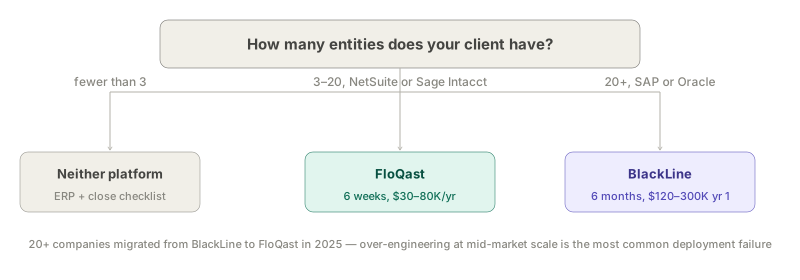
FloQast is the right choice for mid-market organisations with 3–20 entities, revenue between $50M and $500M, and accounting teams that want a structured close without abandoning Excel. Implementation in 4–6 weeks, G2 ease-of-use score of 9.3, and ROI typically within 8–12 months. BlackLine is the right choice for enterprises with 20+ entities, complex intercompany accounting, active SOX compliance requirements, and the budget and bandwidth for a 5–6 month implementation. For clients with fewer than 3 entities and revenue under $30M, neither platform makes economic sense — the ROI does not justify the deployment cost at that scale.
Side-by-Side Comparison
| FloQast | BlackLine | |
|---|---|---|
| Target market | Mid-market, $50M–$500M revenue | Enterprise, $500M+ |
| Entities supported | 3–20 practical limit | 20–500+ |
| Annual licence | ~$12K–$80K | ~$40K–$500K+ |
| Implementation time | 4–8 weeks | 4.5–6+ months |
| Implementation cost | ~$15K–$40K | ~$40K–$120K |
| ERP depth: SAP/Oracle | ✓ basic | ✓ SAP-certified, deep |
| ERP depth: NetSuite/Sage Intacct | ✓ deep, native | ✓ supported |
| Intercompany matching | ✓ basic | ✓ dedicated hub |
| Transaction matching (high volume) | ✗ | ✓ enterprise-grade |
| Journal entry management | ✓ basic | ✓ full approval workflow |
| SOX compliance | ✓ audit trails | ✓ enterprise SOX controls |
| G2 ease of use score | 9.3 / 10 | 8.6 / 10 |
| G2 support score | 9.4 / 10 | 8.6 / 10 |
| Time to ROI | 8–12 months | ~25 months |
| User adoption within 60 days | ~95% | Typically 40–60% |
FloQast
FloQast was founded in 2013 by Mike Whitmire, a former Big Four auditor who built the product around the actual workflows he encountered in corporate accounting teams. The platform has grown to 3,500+ customers — primarily mid-market companies on NetSuite, Sage Intacct, and QuickBooks — and has raised over $200 million in venture funding.
The distinguishing philosophy: FloQast does not try to replace how your team works. It structures the close around your existing ERP data, your existing reconciliation templates, and your existing Excel-based workflows. Accountants can paste data from spreadsheets, view reconciliations in familiar grid formats, and use formulas they already know. The close checklist becomes the single source of truth for what is done, what is pending, and what is blocked — without requiring teams to move their data into a new system.
Pricing
FloQast starts at approximately $12,000–$25,000 per year for smaller deployments and runs $30,000–$80,000 for mid-market organisations based on entity count and modules. Pricing is custom-quoted and not published; companies report negotiating 20–30% discounts on baseline quotes. Implementation services add approximately $15,000–$40,000 for a standard deployment. ROI arrives within 8–12 months based on time savings on the close cycle.
What Works Well
Implementation in weeks, not months. FloQast averages 4–8 weeks from contract signing to live close management. Internal finance teams handle most of the setup without external consultants. For a practice advising a client on close software, this is the factor that most directly affects the client relationship: a six-week deployment that goes live during a quiet period is operationally very different from a six-month project that disrupts three close cycles.
User adoption is genuinely high. G2’s ease-of-use score of 9.3 out of 10 reflects a consistent pattern in user reviews: FloQast’s interface is intuitive enough that accounting teams adopt it without the resistance that typically accompanies new close software. The platform reports 95%+ user adoption within 60 days. For a CPA firm recommending software to a client, adoption rate matters as much as feature depth — a tool the accounting team actually uses consistently outperforms a technically superior tool they work around.
NetSuite and Sage Intacct integration is production-grade. For clients on these platforms — the dominant mid-market ERPs — FloQast’s real-time GL balance retrieval, live variance detection, and period-lock coordination make the close workflow genuinely automated rather than just tracked. The accounting team sees current-period actuals versus expectations without manual data pulls.
FloQast Compliance (the SOX testing module) handles documentation of internal controls, test evidence, and deficiency tracking. For mid-market companies approaching an audit or preparing for a potential IPO, this module closes a compliance gap without requiring BlackLine’s full enterprise architecture.
One thing I look at when evaluating this for clients: FloQast’s close checklist approach is most valuable when the close problem is coordination — tasks falling through the cracks, unclear ownership, no visibility into what is blocked. If the problem is automation depth — matching millions of transactions, eliminating intercompany discrepancies across 30 entities — FloQast addresses the coordination problem well but the automation problem less so.
What Does Not Work Well
High-volume transaction matching is not FloQast’s strength. BlackLine’s matching engine handles millions of transactions per reconciliation cycle, with 90%+ auto-match rates on high-volume accounts. FloQast’s reconciliation approach is management-oriented rather than matching-oriented — it tracks whether reconciliations are complete and reviewed, but does not automate the underlying matching logic to the same depth. For clients with large clearing accounts, high intercompany volumes, or bank reconciliations with thousands of daily transactions, this gap is meaningful.
Journal entry workflow is limited. For organisations where journal entry management — preparation, approval routing, audit trail — is a significant part of the close process, FloQast’s journal entry module covers the basics but lacks BlackLine’s structured workflow. G2 scores this at 6.8 for FloQast versus 8.4 for BlackLine. If your client’s close bottleneck is specifically JE approval cycles, FloQast is not the complete solution.
FloQast has practical limits beyond 20 entities. The platform supports multi-entity close management, but users consistently report that complexity increases non-linearly above 20 entities. For clients planning significant M&A activity or managing complex subsidiary structures, this ceiling matters.
FloQast Pros and Cons
Pros:
- 4–8 week implementation — the fastest deployment in the close management market
- 9.3/10 ease of use on G2 — accounting teams actually adopt it
- Deep NetSuite and Sage Intacct integration with live GL data
- SOX compliance module handles audit prep without enterprise overhead
- ROI within 8–12 months — significantly faster than BlackLine
Cons:
- High-volume transaction matching is limited versus BlackLine
- Journal entry workflow module is basic — not suitable for complex JE approval requirements
- Practical entity limit around 20 — not designed for large enterprise complexity
- Pricing is custom and opaque — negotiate from the baseline
The right choice for mid-market accounting teams on NetSuite or Sage Intacct — 4–8 week implementation, 95% user adoption, and ROI within 8–12 months make it the lowest-risk close platform at this scale.
BlackLine
BlackLine was founded in 2001 by Therese Tucker, one of the pioneers of cloud-based financial close automation. The company went public in 2016 and was acquired by Thoma Bravo in 2024. It serves 4,300+ customers, including a significant portion of Fortune 500 and Global 2000 organisations, and generates over $650 million in annual recurring revenue.
BlackLine’s architecture was built reconciliation-first and expanded into close task management, journal entries, intercompany accounting, and variance analysis. This heritage shows in its strengths: the transaction matching engine, intercompany hub, and SOX-grade documentation are the best in the market. It also shows in its weaknesses: the platform’s enterprise depth creates implementation complexity and administrative overhead that many mid-market deployments cannot absorb.
The market has noticed. BlackLine’s market share declined from 24.4% to 18.2% between 2024 and 2025, while FloQast grew. Over 20 companies migrated from BlackLine to FloQast in the same period, with the most common reasons being failed implementations, poor user adoption, and ongoing administrative overhead from maintaining an over-engineered system.
Pricing
BlackLine does not publish pricing. Mid-market deployments (10–20 entities, 10–20 finance users) typically run $40,000–$80,000 per year depending on modules. Enterprise deployments with full module suites run $150,000–$500,000+. Implementation adds $40,000–$120,000 for professional services. Annual price increases of 4–6% apply as new features launch. Time to positive ROI averages 25 months.
For a CPA firm advising on BlackLine, the total first-year cost including implementation is typically $80,000–$200,000 for a mid-enterprise deployment. This is a significant recommendation to make — ensure the entity count and complexity genuinely warrant it before signing the client up.
What Works Well
Transaction matching at enterprise scale is BlackLine’s technical differentiator. The AI-powered matching engine handles millions of transactions per reconciliation cycle with 90%+ auto-match rates on well-configured accounts. For clients with high-volume clearing accounts, intercompany accounts at scale, or bank reconciliations involving hundreds of thousands of daily transactions, no other platform in this comparison handles that volume reliably.
The intercompany hub is the best in the market. Organisations with 20+ entities spend 25–40% of their close cycle on intercompany eliminations, matching, and dispute resolution. BlackLine’s intercompany module handles matching, dispute resolution, and netting across entities with automated workflow that tracks resolution status in real time. For a holding company with 30 operating subsidiaries, this is not a nice-to-have — it is the capability that determines whether the consolidated close is possible in 5 days or 15.
SOX-grade compliance documentation. BlackLine’s risk stratification framework, evidence attachment, control testing workflow, and audit-ready reporting are purpose-built for publicly traded companies with active external audit requirements. For pre-IPO clients building the compliance infrastructure they will need post-listing, BlackLine’s architecture is the right investment.
SAP integration is the deepest available. BlackLine holds SAP-certified connectors with bidirectional data flow — the standard for organisations where SAP is the ERP backbone. For Global 2000 companies on SAP, no competitor matches BlackLine’s integration depth.
What Does Not Work Well
Implementation is a significant organisational undertaking. A standard BlackLine deployment takes 4.5–6 months and typically requires a dedicated internal administrator and professional implementation partners. For accounting teams running monthly closes throughout the implementation period, this is genuinely disruptive. User reviews on G2 consistently describe the implementation as having a steep learning curve, with some describing the interface as “clunkiest software, seems dated from the 90s.”
Administrative overhead does not end at implementation. BlackLine requires ongoing administration — configuration maintenance, user management, module updates — that demands either a dedicated resource or regular professional services engagement. For mid-market organisations without a dedicated finance systems administrator, this ongoing cost is frequently underestimated during the sales process.
Over-engineering risk for sub-enterprise deployments. Finance teams at companies with fewer than 20 entities consistently report that BlackLine’s feature depth exceeds what they actually use. The sunk cost of the implementation then prevents migrating to a more appropriate platform. If a CPA firm is recommending BlackLine to a client with 8 entities on NetSuite, that recommendation needs to be stress-tested against the implementation risk and ongoing overhead.
BlackLine Pros and Cons
Pros:
- Enterprise-grade transaction matching — 90%+ auto-match on high-volume accounts
- Best-in-class intercompany hub for 20+ entity organisations
- SOX compliance documentation built for public company audit requirements
- SAP-certified connectors — the standard for Global 2000 organisations
- 4,300+ enterprise customers — the most battle-tested platform in the market
Cons:
- 4.5–6 month implementation with $40K–$120K implementation cost
- Ongoing administrative overhead requires dedicated resource
- User adoption resistance — 8.6/10 ease of use versus FloQast’s 9.3
- Market share declining as mid-market migrates to FloQast and alternatives
- Over-engineered for organisations under 20 entities
The right platform for enterprise organisations with 20+ entities, complex intercompany accounting, and active SOX requirements — its transaction matching engine and intercompany hub are the deepest in the market at this scale.
Which Tool Fits Which Firm?
Recommend FloQast when: The client has 3–20 entities, runs NetSuite or Sage Intacct, and the close problem is coordination — tasks falling through the cracks, unclear ownership, no visibility into what is blocked. Expected deployment: 4–8 weeks. Budget: $50,000–$120,000 all-in for Year 1. ROI: 8–12 months.
Recommend BlackLine when: The client has 20+ entities, uses SAP or Oracle, has active SOX requirements or is preparing for an IPO, and processes thousands of intercompany transactions per close cycle. Expected deployment: 5–7 months. Budget: $120,000–$300,000 all-in for Year 1. ROI: 18–25 months.
Recommend neither when: The client has fewer than 3 entities, revenue under $30M, and a close cycle managed by 1–2 people. At this scale, a well-configured cloud ERP (NetSuite or QuickBooks) with a structured close checklist in a project management tool delivers 80% of the benefit at 5% of the cost. Both platforms require a minimum level of organisational complexity to justify their investment.
A Note on the Mid-Market Migration from BlackLine
One pattern worth flagging for practices advising clients on close software: over 20 companies migrated from BlackLine to FloQast in 2025, with failure rates in BlackLine implementations being the primary driver. The failure mode is consistent — a mid-market company with 8–15 entities selects BlackLine because it is the category leader, spends six months implementing it, achieves 40–50% user adoption, and then runs BlackLine alongside their previous close spreadsheets rather than replacing them.
The lesson is not that BlackLine is a poor product. It is that BlackLine is an enterprise product, and deploying it in a mid-market environment creates an organisational mismatch that no amount of training resolves. If a client’s close involves fewer than 20 entities and their ERP is not SAP or Oracle, the default recommendation should start with FloQast and move up to BlackLine only if a specific capability gap justifies the premium.
Pricing verified against multiple sources including G2, Coefficient, and vendor documentation as of April 2026. Both platforms use custom pricing — treat benchmarks as indicative, not contractual. Always request formal quotes and verify implementation costs in writing before client commitment.
This is not financial or legal advice. Last reviewed: April 2026.