

Botkeeper Alternatives 2026: Bookkeeper360, Pilot and Xendoo Compared
Botkeeper shut down in February 2026. If your firm had built workflows around it — automated transaction coding, monthly reconciliation, client-facing reporting — you are now looking at a gap in your tech stack during one of the busiest periods of the year.
The closure was sudden. CEO Enrico Palmerino announced on 7 February that the platform was winding down, citing a “perfect storm” of macroeconomic shifts and unexpected consolidation among its largest CPA firm clients. Nearly $90 million in funding and 11 years of operation were not enough to survive the revenue shock. Three weeks later, Xendoo acquired Botkeeper’s core AI engine, Botkeeper Infinite, keeping that platform alive — but under new ownership with an undefined long-term roadmap.
This article is for CPA firms and small businesses that need a concrete answer: what do you move to, and what are the real trade-offs? I have compared three platforms — Bookkeeper360, Pilot, and Xendoo (which now carries Botkeeper Infinite) — across pricing, accounting method, software compatibility, and fit for small practices across the US, UK, and Canada.
Quick Verdict
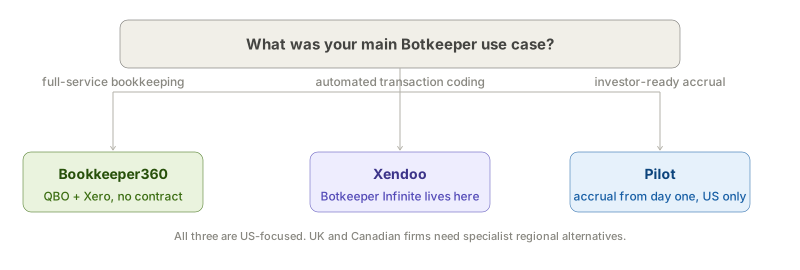
Bookkeeper360 is the most versatile replacement for CPA firms serving US-based SME clients, with flexible pricing, support for both QuickBooks and Xero, and a range of add-on services. Pilot is a strong choice for US tech startups that need accrual bookkeeping and investor-ready reporting, but it is not available to non-US entities. Xendoo is the most direct successor for firms that ran transaction automation through Botkeeper Infinite, but the acquisition is recent and long-term stability should be verified before full commitment.
Side-by-Side Comparison
| Feature | Bookkeeper360 | Pilot | Xendoo |
|---|---|---|---|
| Starting price (monthly) | ~$399/mo | ~$499/mo (Core, annual) | $395/mo (Essentials) |
| Pricing model | Expense-volume tiers | Expense-volume, billed annually | Expense-volume tiers |
| Free trial | ✗ | ✗ | ✓ 30-day money-back |
| Cash-basis accounting | ✓ | ✓ (Starter/Core) | ✓ |
| Accrual-basis accounting | ✓ | ✓ (all plans) | ✓ (Growth and above) |
| QuickBooks integration | ✓ | ✓ (QBO only) | ✓ |
| Xero integration | ✓ | ✗ | ✓ |
| Dedicated bookkeeper | ✓ | ✓ | ✓ |
| Tax services add-on | ✓ | ✓ | ✓ |
| Payroll services | ✓ (from $200/mo) | ✗ (self-managed via QBO) | ✓ |
| CFO advisory | ✓ (from $2,000/mo) | ✓ ($450/hr) | ✓ |
| AI automation layer | Partial | Partial | ✓ (Botkeeper Infinite) |
| US entities only | ✓ | ✓ (US entities only) | ✓ (primarily US) |
| Suitable for UK/Canada | ✗ | ✗ | Limited |
| No long-term contract | ✓ | ✗ (annual billing) | ✓ |
What Happened to Botkeeper — and Why It Matters for Your Decision
Before evaluating alternatives, it is worth understanding what actually brought Botkeeper down. The failure was not technological. By late 2025, Botkeeper’s Infinite platform was coding over 80% of transactions automatically with 98% accuracy — genuinely impressive for production bookkeeping workloads. The problem was business model concentration: a small number of large CPA firm clients represented a disproportionate share of revenue. When several of those firms were acquired in the M&A wave that reshaped the profession in Q4 2025, Botkeeper’s revenue collapsed faster than it could adapt.
The lesson for choosing a replacement is not about features — it is about vendor risk. Any platform still in venture-backed growth mode, reliant on a narrow client base, or operating without a clear path to profitability carries structural risk that does not show up in feature comparisons. When evaluating the three platforms below, I have noted what is publicly known about each firm’s financial stability alongside the functionality.
Botkeeper Infinite was acquired by Xendoo on 27 February 2026 and remains operational. If you were on Botkeeper Infinite through your CPA firm, the platform is still running — but Xendoo’s integration plans and pricing structure for Infinite going forward have not been fully disclosed.
Bookkeeper360
Bookkeeper360 has been operating since 2012 and serves small to mid-sized US businesses through a hybrid of dedicated human bookkeepers and proprietary dashboard technology. It integrates with both QuickBooks Online and Xero — which is the most important compatibility advantage it holds over Pilot — and offers a modular service stack that lets firms add payroll, tax, back-office, and CFO support without switching platforms.
Pricing
Bookkeeper360’s cash-basis monthly reconciliation plans start at approximately $399/month for businesses with up to $20,000 in monthly expenses, based on publicly listed pricing verified through NerdWallet’s February 2026 review. Add-ons are priced separately: payroll from $200/month, tax services from $550 for individuals or $1,000 for organisations, back-office support from $150/month, and CFO advisory from $2,000/month.
The add-on model is flexible but can escalate quickly. A firm starting at $399 that adds payroll and back-office support will realistically be paying closer to $750–850/month before tax preparation. Run the full numbers against your actual service mix before signing up.
What Works Well
Dual-platform compatibility — QuickBooks and Xero — is Bookkeeper360’s most practical advantage. Most alternatives in this category lock you into one platform. Firms with a mixed-software client base, or those migrating clients between systems, are not forced to choose.
The proprietary mobile dashboard offers real-time financial reporting, cash flow visibility, goal tracking, and direct messaging with your assigned bookkeeper. For CPA firms managing their own back-office, this is a cleaner interface than pulling reports directly from QBO or Xero.
No long-term contract is required. You can change or cancel your plan without penalty, which directly addresses the risk that Botkeeper’s closure exposed — being locked into a platform that might not be around next quarter.
Based on user reviews on G2 and Capterra, the dedicated account manager model is genuinely valued by clients. Response times and bookkeeper continuity are cited as strengths across a broad range of review sources.
What Does Not Work Well
Communication issues are a recurring complaint. Capterra reviews include accounts of reconciliation work left incomplete for months and slow follow-up from the assigned bookkeeper. This is not universal, but it appears in enough reviews to be a pattern rather than an outlier.
CFO advisory pricing is prohibitive for small firms. At $2,000/month as a starting point, fractional CFO services through Bookkeeper360 are priced for mid-market businesses, not sole practitioners or two-person CPA firms.
No UK or Canada support. Bookkeeper360 is built for US entities and US tax treatment. UK firms dealing with HMRC obligations and Canadian firms working within CRA requirements will need to look elsewhere.
Bookkeeper360 Pros and Cons
Pros:
- Supports QuickBooks Online and Xero — no platform lock-in
- No long-term contract
- Modular add-ons: payroll, tax, CFO advisory under one roof
- Established since 2012 — 14-year track record reduces vendor risk
- Strong user ratings on dedicated bookkeeper quality
Cons:
- Add-ons stack up quickly and the real cost is rarely the headline price
- Communication delays reported by multiple reviewers
- CFO services start at $2,000/month — not accessible for micro-firms
- US-only — no UK or Canada service
Supports both QuickBooks and Xero with no long-term contract — the most practical Botkeeper replacement for US CPA firms that need flexibility across their client software stack.
Pilot
Pilot positions itself as the bookkeeping partner of choice for high-growth startups, particularly in tech and e-commerce. It runs on QuickBooks Online exclusively, bills annually, and prices based on your company’s monthly expense volume. Accrual-basis accounting is available from the entry plan — which is the feature that sets Pilot apart from many competitors who default to cash basis at lower price points.
Pricing
Pilot’s Core plan starts at approximately $499/month for businesses with up to $30,000 in monthly expenses, billed annually with an onboarding fee equal to one month of bookkeeping. Pricing scales with expense volume and maxes out at $839/month for up to $199,999 in monthly expenses at the Core tier. The Plus plan, which covers multiple entities, AR/AP, inventory tracking, and billable expenses, starts from $1,500/month on a custom basis.
One pricing mechanic to understand: Pilot averages your prior three months of expenses each month and adjusts your tier accordingly. If your business is growing, your bookkeeping cost will increase automatically. Firms that experienced rapid growth with Botkeeper should model what their Pilot cost would look like 12 months out, not just today.
All plans are prepaid annually. Refund terms should be verified directly with Pilot before signing.
What Works Well
Accrual-basis from day one means no painful transition later. For startups preparing for investor due diligence, raising a financing round, or working toward an audit, accrual accounting is non-negotiable. Pilot’s baseline offering meets that standard without requiring an upgrade.
The Pilot dashboard and task management system are consistently praised in user reviews for clarity and ease of use. Financial statements are formatted for external audiences — lenders, investors, auditors — not just internal review.
Controller support is included on the Core plan, which provides guidance on revenue recognition, COGS classification, and CapEx treatment. For early-stage companies without a finance hire, this is meaningful oversight that most bookkeeping services charge separately for.
Pilot integrates directly with QuickBooks Online, Stripe, Gusto, and a wide range of startup-relevant platforms. Data portability is explicit in their FAQ: if you leave Pilot, your QBO data goes with you.
What Does Not Work Well
Annual billing with limited refund flexibility is a meaningful risk for any firm that had its bookkeeping provider disappear without warning. Verify the current refund policy directly before committing.
US entities only. Pilot’s FAQ is explicit: it does not support foreign entities. UK and Canadian firms cannot use Pilot.
No payroll management. Pilot does not handle payroll on your behalf. If your clients run payroll through Gusto or ADP, you manage that separately — Pilot accounts for it in the books but does not administer it.
Hourly add-on rates are steep. AP/AR management and certain advisory tasks are billed at $145/hour as supplemental services. For firms with complex AP workflows, this can add substantial unexpected cost.
Delivery speed has been flagged by reviewers. Multiple G2 and Capterra reviews note that monthly books can take 30+ days to close. For CPA firms that need timely financials to manage their own client reporting cadence, this is a significant operational constraint.
Pilot Pros and Cons
Pros:
- Accrual-basis accounting included on all plans
- Controller-level guidance on Core and above
- Clean, investor-ready financial reporting
- Strong integrations with startup-relevant platforms (Stripe, Gusto)
- Data portability via QuickBooks Online
Cons:
- Annual billing, no monthly option
- US entities only — no UK or Canada
- No payroll administration
- Books can take 30+ days — slow delivery for time-sensitive practices
- AP/AR add-ons billed at $145/hour
- QuickBooks Online only — no Xero compatibility
Accrual-basis bookkeeping included from day one with controller support — the strongest option for US tech startups that need investor-ready financials without building an internal finance team.
Xendoo (with Botkeeper Infinite)
Xendoo has been providing online bookkeeping and accounting services since 2016 and reached profitability in 2025 before acquiring Botkeeper Infinite in March 2026. That acquisition is the most important context for any CPA firm evaluating Xendoo right now: the platform now operates two distinct service lines — its traditional direct-to-SMB bookkeeping service, and Botkeeper Infinite, which is the automated transaction coding and reconciliation engine built specifically for CPA firms managing multiple client entities.
Pricing
Xendoo’s standard plans are tiered by monthly expense volume: Essentials at $395/month (weekly bookkeeping, monthly financials, bank and credit card reconciliation), Growth at $695/month (adds tax consultant access and modified accrual), and Scale at $995/month (custom chart of accounts and deferred revenue schedules). Custom plans are available for businesses with over $125,000 in monthly expenses.
A 30-day money-back guarantee applies to all plans — the only one of the three platforms reviewed here that offers this.
Botkeeper Infinite pricing under Xendoo’s ownership has not been fully publicly disclosed as of April 2026. Firms using Infinite should contact Xendoo directly to confirm ongoing contract terms.
What Works Well
Botkeeper Infinite is still running. For CPA firms that had built their automated workflows around Botkeeper Infinite’s transaction coding, reconciliation automation, and client management modules, Xendoo has committed to continuity. The platform is operational, customer success teams are taking new orders, and Botkeeper’s founder has indicated a significant upgrade to Infinite is expected before the end of 2026.
Xendoo’s own bookkeeping service offers weekly reconciliations rather than monthly — a faster close cadence than either Bookkeeper360 or Pilot at comparable price points.
The Xendoo Insights XP dashboard and Xero compatibility distinguish it from Pilot. Firms with Xero-based clients have a viable path to a full-service bookkeeping solution without forcing a software migration.
Xendoo’s growth record — consistent double-digit year-over-year growth and clear profitability before the acquisition — is the most encouraging vendor stability signal of the three platforms reviewed here.
What Does Not Work Well
The Botkeeper Infinite acquisition is very recent. Integration, support staffing, and product roadmap decisions are still being worked through. Firms that had specific support SLAs with Botkeeper Infinite should verify those terms apply under Xendoo’s ownership before relying on them.
US-centric service model. Like Bookkeeper360 and Pilot, Xendoo’s primary market is US-based businesses. UK and Canadian firms should not assume coverage without explicit confirmation.
Tax service charges have generated complaints. Reviews on the BBB and Google note unexpected charges for tax return preparation. Before adding tax services, request a full cost breakdown in writing.
Xendoo Pros and Cons
Pros:
- Most direct successor for Botkeeper Infinite users — platform is live and supported
- Weekly reconciliation cadence — faster than monthly-close competitors
- Supports both QuickBooks Online and Xero
- 30-day money-back guarantee — lowest commitment risk of the three
- Profitable before acquisition — better vendor stability signal than VC-dependent peers
Cons:
- Botkeeper Infinite’s long-term roadmap under Xendoo is still being defined
- Tax service costs have surprised some clients — get full pricing in writing upfront
- US-centric — limited applicability for UK and Canadian practices
- Pricing for Botkeeper Infinite specifically has not been publicly confirmed post-acquisition
The most direct path to continuity for firms that ran workflows on Botkeeper Infinite, now with weekly reconciliation and the lowest commitment risk of the three platforms reviewed.
A Note on UK and Canadian Practices
All three platforms reviewed here primarily serve US-based businesses. If you are running a CPA practice in the UK or Canada and used Botkeeper’s document or workflow automation features, your path is different.
For UK practices, regional alternatives with HMRC-compliant workflows include FreeAgent (built-in MTD support), Dext for document capture, and specialist outsourced bookkeeping services that understand the UK regulatory environment.
For Canadian practices, CRA-compliant bookkeeping services are offered by a smaller pool of platforms. Wave (free, Toronto-based) covers basic needs; QuickBooks Online Canada and Xero are the dominant platforms; and outsourced bookkeeping services that explicitly state CRA familiarity are preferable to US-oriented automation platforms.
If you are a US-headquartered practice with UK or Canadian client entities, contact Xendoo directly about their capacity to support consolidated reporting for international subsidiaries.
Which Tool Is Right for You?
Choose Bookkeeper360 if: Your CPA firm or small business uses both QuickBooks and Xero across your client base, you want a modular service structure where you can add payroll and tax without switching vendors, and you value contract flexibility over the lowest headline price. Best for US-based practices serving a mixed-software SME client portfolio.
Choose Pilot if: Your client is a US-incorporated tech startup, SaaS business, or high-growth company that needs investor-ready accrual accounting, burn-rate reporting, and a clean dashboard for lender or investor presentations. Pilot is not the right fit for traditional CPA workflow automation or non-US entities.
Choose Xendoo if: Your firm ran transaction coding and reconciliation through Botkeeper Infinite and you need continuity on that platform, or you want weekly reconciliation with Xero support at a lower entry cost than Bookkeeper360. Also the strongest choice for practices that want a money-back guarantee before full commitment.
If you are in the UK or Canada: None of the three platforms reviewed here is purpose-built for your regulatory environment. Treat this comparison as a reference point rather than a recommendation, and evaluate regional alternatives alongside any US-based platform before deciding.
This is not financial or legal advice. Pricing and service terms are subject to change — verify directly with each vendor before purchasing. Botkeeper Infinite’s terms under Xendoo ownership in particular should be confirmed directly.
Last reviewed: March 2026. Spotted outdated information? Write to info@kynledger.com.