

Vic.ai Alternatives 2026: Cheaper AI Invoice Processing That Actually Works
Vic.ai is a genuinely capable platform. Its AI — trained on over one billion invoices — achieves 85% no-touch processing within six months and reduces invoice handling cost from around $12 to under $2 per invoice at scale. But it is priced for enterprise finance departments with hundreds or thousands of invoices per month and complex ERP environments. For most CPA firms and small accounting practices, Vic.ai is overkill on both features and budget.
The alternatives in this comparison are not watered-down substitutes. BILL, Stampli, and Dext each solve a real segment of the AP automation problem — at prices that make sense for firms processing 20 to 500 invoices per month. The question is not “which is closest to Vic.ai” but “which one matches your actual volume, workflow, and budget.”
This article covers USA and UK practices. All pricing is in USD unless otherwise noted.
Quick Verdict
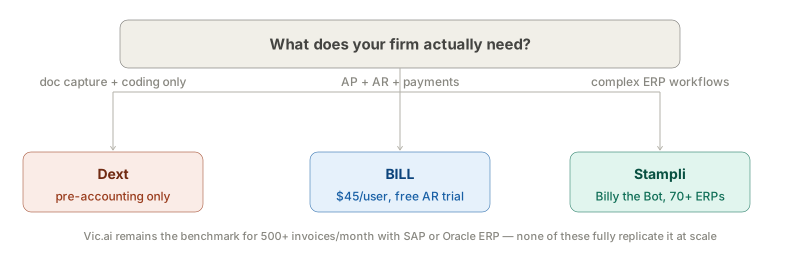
BILL is the right starting point for small practices and CPA firms managing client AP at low-to-moderate volume — transparent per-user pricing, free trial, and deep QuickBooks/Xero integration. Stampli is the best mid-market alternative to Vic.ai for firms with complex ERP environments and multi-step approval workflows. Dext is the correct choice if you need document capture and pre-accounting automation without full AP payment execution.
Where Vic.ai Fits — and Where It Doesn’t
Before comparing alternatives, it is worth being specific about what Vic.ai actually does that its competitors do not replicate fully.
Vic.ai’s core differentiator is genuine autonomy. Its AI makes GL coding decisions and routes approvals without human review — not just OCR extraction with rule-based routing. By month six, clients typically achieve 85%+ straight-through processing, meaning most invoices are coded, approved, and queued for payment without anyone touching them. It integrates natively with SAP, Oracle, NetSuite, and major ERPs.
The firms that genuinely need this are processing 500+ invoices per month with complex PO matching requirements, multi-entity structures, and ERP environments where a miscoded invoice has material financial consequences.
For firms processing 20–200 invoices per month on QuickBooks or Xero, the alternatives below deliver 70–85% of the value at 20–40% of the cost.
AP Automation Coverage: What Each Tool Actually Does
| Stage | Dext | BILL | Stampli | Vic.ai |
|---|---|---|---|---|
| Invoice capture / OCR | ✓ | ✓ | ✓ | ✓ |
| GL coding suggestions | Partial | ✓ | ✓ (Billy the Bot) | ✓ Autonomous |
| Approval routing | ✗ | ✓ | ✓ Advanced | ✓ Autonomous |
| PO matching (2/3-way) | ✗ | ✗ (Team+) | ✓ | ✓ |
| Payment execution | ✗ | ✓ ACH/check/wire | ✓ Direct Pay | ✓ VicPay |
| AR automation | ✗ | ✓ | ✗ | ✗ |
| ERP integration | QBO, Xero | QBO, Xero, NetSuite | 70+ ERPs | SAP, Oracle, NetSuite |
| Starting price | ~$208/mo (10 clients) | $45/user/mo | Custom | Custom enterprise |
| Free trial | ✓ 14 days | ✓ | ✗ | ✗ |
| Best for | CPA pre-accounting | SMBs, AP + AR | Mid-market AP | Enterprise |
BILL (formerly Bill.com)
BILL is the most accessible AP automation platform in this comparison, with publicly listed pricing, a free trial, and the broadest accounting software integration of the three alternatives. It is used by more than 400,000 businesses and is the AP tool of choice for over 85 of the top 100 US accounting firms, based on publicly available data.
What BILL Does Well
Transparent per-user pricing is the clearest advantage over both Stampli and Vic.ai. The Essentials plan starts at $45 per user per month, Team at $55, and Corporate at $79. You can model your exact cost before speaking to a sales team.
BILL handles both accounts payable and accounts receivable in a single platform — the only tool in this comparison that does both. For small CPA firms managing client cash flow holistically, this removes the need for a separate AR tool.
The two-way sync with QuickBooks Online, QuickBooks Enterprise, Xero, Sage Intacct, Oracle NetSuite, and Microsoft Dynamics is among the deepest in the SMB market. Transactions flow back to the ledger automatically without manual reconciliation steps.
BILL Spend & Expense (the former Divvy product) is free — no monthly fee — and includes corporate cards, virtual cards, budget tracking, and expense management. For CPA firms looking to consolidate spend visibility across client entities, this free layer adds meaningful value.
What Does Not Work Well
Per-user plus per-transaction fees compound quickly. ACH payments cost $0.59 each, instant transfers 1% of the amount, and card payments 2.9%. A firm processing 200 monthly invoices paid via ACH adds $118 to the base subscription cost. Model the full cost, not just the headline per-user price.
AI extraction is functional but not autonomous. BILL’s OCR catches the standard fields reliably, but it does not learn your GL coding patterns and apply them without review the way Vic.ai’s or Stampli’s AI does. You will spend more time on manual coding review for non-standard invoice formats.
No PO matching on the Essentials tier. Two and three-way PO matching requires at least the Team plan, which is fine for simple AP workflows but a gap for clients with purchase order requirements.
Based on G2 and Capterra reviews, periodic sync issues with QuickBooks Online are a recurring complaint — worth testing thoroughly in your environment before rolling out across client accounts.
BILL Pros and Cons
Pros:
- Transparent per-user pricing — no enterprise negotiation required
- AP and AR in one platform
- Free Spend & Expense module with corporate cards
- 85 of the top 100 US accounting firms use it — strong ecosystem
- Free trial available
Cons:
- Per-transaction fees add materially to total cost at volume
- AI extraction does not learn coding patterns autonomously
- PO matching limited to Team plan and above
- Periodic QuickBooks sync issues reported in user reviews
- No native UK entity support for HMRC-specific workflows
The only AP automation tool in this comparison that covers both payables and receivables with transparent pricing — strongest choice for small CPA firms managing full client cash flow on QuickBooks or Xero.
Stampli
Stampli is the closest feature-equivalent to Vic.ai in this comparison, built for mid-market companies that need genuine AI-driven AP automation without the enterprise implementation timeline or opaque pricing of Vic.ai. Its AI assistant, Billy the Bot, is trained on over 83 million hours of real finance work and operates across the full procure-to-pay lifecycle.
What Stampli Does Well
Billy the Bot is the practical differentiator. Once trained on your chart of accounts and vendor patterns, Billy extracts invoice data, suggests GL codes, routes approvals to the correct person, and flags exceptions — reducing the manual review burden in a way that BILL’s more static OCR does not. Based on user reviews on G2 (4.6 stars, 1,800+ reviews), Billy’s accuracy improves meaningfully over the first 60–90 days of use.
ERP integration depth is Stampli’s clearest advantage over BILL for mid-market clients. It connects with 70+ ERP and accounting systems including QuickBooks, Xero, NetSuite, Sage Intacct, Microsoft Dynamics, and Acumatica — mirroring your ERP’s chart of accounts, entities, and approval hierarchies without requiring ERP reconfiguration.
Invoice-centric collaboration keeps all communication — between approvers, between finance and operations, and between your firm and vendors — directly on the invoice. This eliminates the email trail problem that makes AP audits painful and ensures nothing gets lost in approval chains.
Stampli’s implementation timeline is weeks, not months — a meaningful contrast to Vic.ai, which typically requires a longer onboarding process.
What Does Not Work Well
No public pricing. Every Stampli engagement requires a custom quote based on invoice volume and feature requirements. This makes budget planning harder upfront — you cannot self-serve a price before committing to a sales conversation.
No AR module. Unlike BILL, Stampli is AP-only. For practices managing both payables and receivables, a second tool is required.
Based on user reviews, customer service quality has declined over the past year — this appears in multiple G2 and Capterra reviews as a pattern rather than isolated feedback. Confirm support SLAs before signing.
GL account access control is limited. Users can see all GL accounts in the coding interface, which requires additional process controls to prevent miscoding. Experienced Stampli users flag this as an ongoing gap.
Stampli Pros and Cons
Pros:
- Billy the Bot learns and applies your coding patterns — closest to Vic.ai’s autonomous capability
- 70+ ERP integrations including NetSuite, Sage Intacct, Dynamics
- 4.6-star G2 rating across 1,800+ verified reviews
- Invoice-centric collaboration creates a clean audit trail
- Weeks-long implementation, not months
Cons:
- No public pricing — requires sales conversation
- No AR module
- Customer service quality complaints increasing in recent reviews
- Cannot restrict GL account visibility per user
- Not purpose-built for UK HMRC or Canadian CRA workflows
Billy the Bot learns your GL coding patterns and handles approval routing across 70+ ERPs — the strongest mid-market Vic.ai alternative for practices with complex multi-step AP workflows.
Dext
Dext sits earlier in the invoice lifecycle than BILL or Stampli. It is not an AP automation platform in the full sense — it does not execute payments or manage approval workflows. What it does is capture, extract, and categorise invoice and receipt data before it reaches QuickBooks or Xero, making it the correct alternative to Vic.ai for CPA firms whose primary need is pre-accounting data capture rather than end-to-end AP automation.
What Dext Does Well
For CPA firms managing client bookkeeping — not client payments — Dext addresses the same root problem as Vic.ai: reducing manual data entry from supplier invoices. Dext’s supplier rules auto-code recurring invoices to the correct GL account and tax code, then publish them to QuickBooks or Xero without manual intervention. On a workflow of 200 documents per month across five clients, well-configured supplier rules remove 2–3 hours of weekly review time.
Dext’s multiple submission methods — mobile snap, email forwarding, WhatsApp, Dropbox — solve the practical problem of getting clients to actually submit their documents, which is often the bigger bottleneck than the coding itself.
The 14-day free trial and the affiliate programme available through KynLedger make Dext the easiest of the three to evaluate before committing.
What Does Not Work Well
Dext is not an AP automation platform. It does not manage payment workflows, approval routing, PO matching, or payment execution. If your clients need those capabilities, Dext is the wrong tool — use BILL or Stampli instead.
The per-client pricing model escalates significantly for practices with many small-volume clients. Practice Plans start at around $208/month for 10 clients on annual billing; firms with 25 micro-clients pay proportionally more for less throughput per client.
Dext Pros and Cons
Pros:
- Supplier rules eliminate manual review for recurring invoices
- Best fit for CPA firms focused on bookkeeping rather than full AP automation
- 14-day free trial — lowest evaluation risk of the three
- Native publish to QuickBooks and Xero with tax codes intact
- 4.8-star Xero App Store rating
Cons:
- Not an AP automation platform — no approval routing, PO matching, or payments
- Per-client pricing penalises firms with many low-volume clients
- Cancellation complaints are a recurring theme in user reviews — verify exit terms upfront
- Line item extraction is plan-gated
If your firm needs pre-accounting automation rather than full AP payment execution, Dext's supplier rules reduce coding time by 2–3 hours per week across a 5-client portfolio — at a fraction of Vic.ai's cost.
Which Tool Is Right for You?
Choose BILL if: You are a CPA firm or SMB managing AP and AR for clients on QuickBooks or Xero, processing fewer than 200 invoices per month, and you need transparent pricing, a free trial, and a platform your clients can use directly without a lengthy onboarding process.
Choose Stampli if: Your mid-market clients have complex approval chains, multi-entity structures, and ERP environments like NetSuite or Sage Intacct — and you need AI-assisted coding that learns your patterns rather than static OCR with manual review. Stampli is the closest practical alternative to Vic.ai for firms that cannot justify enterprise pricing.
Choose Dext if: Your firm’s primary need is getting supplier invoices coded and into QuickBooks or Xero without manual data entry — and your clients do not need automated approval routing or payment execution as part of the same workflow.
Stay on Vic.ai if: Your clients are processing 500+ invoices per month with complex PO matching, multi-entity consolidation, and SAP or Oracle ERP environments where autonomous coding at scale justifies the enterprise investment.
This is not financial or legal advice. Prices and features are subject to change — verify directly with each vendor before purchasing.
Last reviewed: March 2026. Spotted outdated information? Write to info@kynledger.com.