

AI Month-End Close in 2026: The Tools That Actually Cut the Sprint
There are two different month-end close problems, and most of the tools marketed as “AI close automation” solve only one of them.
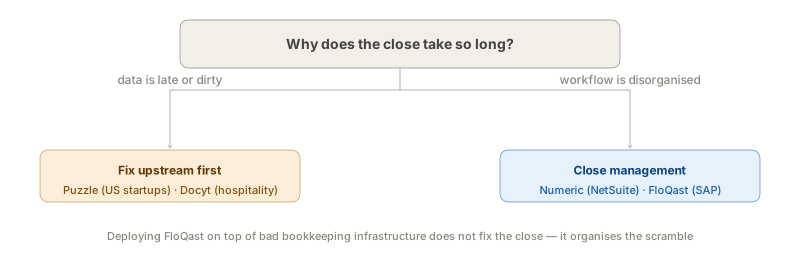
The first problem is a data organisation problem: the data exists in an ERP, but it is scattered across 30 reconciliation tasks, 8 people, and a shared folder of Excel files that nobody fully trusts. The close takes 10 days because nobody has visibility into what is done, what is blocked, and who owns what. FloQast and Numeric solve this problem. They are workflow management platforms that assume the data is there — their job is to coordinate the humans working through it.
The second problem is a data quality problem: the data is late, incomplete, or dirty because the bookkeeping layer upstream is still manual. Bank statements arrive as emailed PDFs. Expense receipts sit in someone’s inbox. Transactions from Stripe or Ramp require manual journal entries because the integration is broken. The close takes 10 days because the first 7 are spent reconstructing what happened, not reviewing it.
Most CPA firms serving SMB clients live in the second problem. A client with two bank accounts, a Stripe feed, and 200 monthly transactions does not have a workflow management failure. They have a data infrastructure failure. Deploying FloQast on top of bad bookkeeping infrastructure is like putting a better task manager on top of a codebase that does not compile.
The tools in this article address both problems — but I have been explicit about which problem each tool is designed to solve, because that determines whether it is the right fit for your client base.
Quick Verdict
Numeric is the best close management platform for mid-market accounting teams — AI-native, transaction-level ERP data refreshed every minute, AI Flux Writer for automated variance analysis, and 20–38% faster close at roughly half of FloQast’s cost. Puzzle is the best AI-native bookkeeping platform for US startup and tech-company clients — continuous reconciliation, native Stripe/Mercury/Ramp integrations, 50% close time reduction, partner-only model that never competes with your firm. Docyt is the strongest multi-entity AI bookkeeping platform for CPA firms managing hospitality, franchise, or real estate portfolios with complex multi-entity structures. FloQast remains the most established close management platform for mid-market teams on Microsoft Dynamics or SAP where integration depth and track record matter — covered fully in our FloQast vs BlackLine comparison.
Side-by-Side Comparison
| Tool | Solves | Best client type | Price from |
|---|---|---|---|
| Numeric | Close coordination | Mid-market, NetSuite/Sage Intacct | Custom |
| Puzzle | Bookkeeping + close | US startups, fintech stack | ~$43–250/mo |
| Docyt | Bookkeeping + close | Multi-entity hospitality/franchise | ~$299/mo |
| FloQast | Close coordination | Mid-market, MS Dynamics/SAP | ~$12K/yr |
The Continuous Close Argument
Before the tools: the concept.
The traditional month-end close is a product of batch-processing accounting software. Transactions accumulated in bank statements. Bank statements arrived monthly. Accountants processed them monthly. The sprint was baked into the infrastructure.
AI-native accounting platforms break this assumption. When a transaction occurs — a Stripe payment, a Ramp expense, a Mercury transfer — the AI categorises, reconciles, and posts it within minutes rather than waiting for a batch import at month-end. The “close” at month-end becomes an accuracy review and a sign-off rather than a reconstruction exercise.
For clients running modern fintech stacks, continuous close is operational in 2026, not theoretical. Puzzle users report bank reconciliations that previously took two hours reducing to five minutes. That is not an improvement in the close sprint — it is the elimination of the sprint as a distinct event.
The limiting factor is not the AI. It is the client’s data infrastructure. Live bank feeds, native integrations with payment processors, and a GL that connects to payroll via API are prerequisites. Clients who still fax supplier invoices and import CSV bank statements from a USB drive are not candidates for continuous close regardless of what software you deploy on top.
For practices with a mixed portfolio, the strategic question is which clients have the infrastructure to benefit from continuous close today, and which ones need to be upgraded first.
1. Numeric — Best AI-Native Close Management
Numeric is the fastest-growing close management platform in the mid-market segment, gaining traction specifically because it addresses the two most common criticisms of FloQast: data refresh speed and AI depth. Where FloQast pulls ERP data on a schedule, Numeric pulls transaction-level data from NetSuite and Sage Intacct every minute. Where FloQast’s variance analysis requires manual input, Numeric’s AI Flux Writer generates draft explanations automatically.
Numeric was founded by accountants and engineers who previously worked in FP&A, and the product reflects that: it is built around how controllers actually think through a close, not around how a project management platform adapted for accounting.
Pricing
Numeric uses custom pricing based on user count and ERP environment. Published benchmarks suggest mid-market deployments run $8,000–$35,000 per year — roughly 40–50% less than comparable FloQast deployments. A free Starter plan covers basic close management for teams evaluating the platform. Implementation typically takes 2–4 weeks, compared to FloQast’s 4–8 weeks.
What Works Well
Transaction-level ERP integration refreshed every minute is the feature that changes the close workflow most materially. When an accountant opens a reconciliation in Numeric, they see current-period actuals from the GL — not the state of the GL as of last night’s batch sync. For accounts where timing matters (accrual accounts, deferred revenue, intercompany), this eliminates the “is this number current?” question that generates most close follow-up emails.
AI Flux Writer generates draft variance analysis explanations automatically. When revenue in a cost centre is 12% above budget, Numeric drafts an explanation based on the underlying transaction data — which revenue lines drove the variance, which cost items moved in the same period, what the prior-period comparison shows. The accountant edits and approves rather than writing from scratch. G2 users consistently cite this as saving 30–60 minutes per close cycle per team member.
Implementation is fast enough to not disrupt a close cycle. At 2–4 weeks, Numeric can be deployed between close cycles rather than during them. This is a practical advantage over longer-implementation alternatives — the disruption risk is lower, and ROI begins at the very next close.
The Numeric Technical Accounting Assistant is worth noting for practices that handle complex accounting memos — ASC 842 lease accounting, revenue recognition analysis, purchase price allocations. It compresses the drafting time for technical accounting documentation materially, and is a differentiator from every other tool on this list.
What Does Not Work Well
ERP integration depth is narrower than FloQast. Numeric’s primary integrations are NetSuite and Sage Intacct. For teams on SAP, Microsoft Dynamics, or Oracle, integration quality is more limited. If your client portfolio skews towards SAP environments, FloQast’s SAP integration is more mature.
Newer product, smaller reference base. Numeric has grown quickly but does not have FloQast’s 3,000+ customer reference base. For practices whose clients require vendor stability as part of their procurement process, this is worth noting.
No intercompany matching module. For clients with 20+ entities and complex intercompany transactions, Numeric handles basic intercompany but lacks the dedicated intercompany hub that BlackLine offers. For single-entity or simple multi-entity environments, this is not a limitation.
Numeric Pros and Cons
Pros:
- Transaction-level ERP data refreshed every minute — the most current data of any close management platform
- AI Flux Writer generates draft variance explanations — the biggest time-saver in the product
- 2–4 week implementation — deploys between close cycles rather than disrupting them
- 40–50% less expensive than FloQast for comparable deployments
- Technical Accounting Assistant for complex memo drafting
Cons:
- Narrower ERP integration depth than FloQast — primarily NetSuite and Sage Intacct
- Smaller customer reference base than FloQast or BlackLine
- No dedicated intercompany matching for complex multi-entity environments
The best AI-native close management platform for mid-market teams on NetSuite or Sage Intacct — real-time ERP data, AI Flux Writer for automated variance explanations, 2–4 week deployment, and 40–50% lower cost than FloQast.
2. Puzzle — Best Continuous Close for US Startup Clients
Puzzle is the platform I recommend first when a client is a US-based startup using modern fintech tools — Stripe for payments, Mercury or Brex for banking, Ramp or Brex for expenses, Gusto or Rippling for payroll. For this client type, Puzzle eliminates the month-end close problem at the source by connecting directly to these platforms via API and categorising transactions in real time as they occur.
The product philosophy is explicitly different from FloQast and Numeric. Those platforms assume a corporate accounting team working through a defined close process. Puzzle assumes a founder or a 1–2 person accounting team that needs the books to stay current continuously without a monthly reconstruction sprint.
Pricing
Puzzle charges per company based on transaction volume, not per user — a meaningful structural advantage for growing teams where adding users would otherwise increase costs. Plans start at approximately $43 per month for startups (Starter), with higher tiers for more transactions and advanced features. All plans include unlimited user seats. A 14-day free trial is available.
The partner-only model for accounting firms means firms get access to Puzzle without a per-seat upcharge, and Puzzle explicitly commits to never offering competing bookkeeping services to your clients.
What Works Well
Native integrations with modern fintech stacks are production-grade, not bolt-on connectors. Puzzle’s direct API integrations with Stripe, Mercury, Brex, Ramp, Gusto, Rippling, and Deel work reliably without the manual journal entries or broken feeds that QBO integrations with these platforms regularly require. This single fact — that the data flows in cleanly without manual intervention — is the prerequisite for everything else in the continuous close workflow.
98% automated categorisation with AI that learns from corrections. After the first 1–2 months of use, Puzzle requires minimal manual categorisation intervention. The AI identifies which Stripe transactions are product revenue, which Ramp transactions are SaaS subscriptions versus T&E, and handles the recurring patterns automatically. Reconciliation that previously took two hours reduces to review-and-sign-off.
Partner-only model is a genuine commercial differentiator for CPA practices concerned about platform competition. QuickBooks Live and Digits with their in-house CPA services directly compete with independent accounting firms. Puzzle’s public commitment to partner-only means recommending Puzzle to clients does not carry the risk of the platform subsequently marketing bookkeeping services to your client relationship.
Real-time burn rate and runway dashboards make Puzzle specifically valuable for venture-backed clients. Investors and boards ask about runway in every meeting; Puzzle surfaces this automatically from live transaction data rather than requiring a month-end report export.
What Does Not Work Well
US-only and startup-focused. Puzzle’s native integrations are designed around the US fintech stack. For UK clients (using Starling, Monzo Business, or Xero-native bank feeds), Canadian clients (CRA-compliant payroll integrations), or any non-US entity structure, Puzzle’s coverage is thinner. The platform is not the right recommendation for practices with significant UK or Canadian SMB portfolios.
Not a close management platform for complex teams. Puzzle automates the bookkeeping layer — it does not provide close checklists, task assignment, approval routing, or the coordinated workflow management that Numeric and FloQast offer. For a client with a 5-person accounting team running a structured close process, Puzzle handles the data preparation but you would still need a close management tool on top.
Limited multi-entity support for complex structures. Puzzle works well for single entities and simple multi-entity startups. For franchise operations or holding companies with complex intercompany structures, Docyt is the better fit.
Puzzle Pros and Cons
Pros:
- Native API integrations with Stripe, Mercury, Ramp, Brex, Gusto — no manual feeds
- 98% automated categorisation — genuine continuous close for modern fintech stacks
- Per-company pricing with unlimited users — cost does not scale with team headcount
- Partner-only model — never competes with your firm for client revenue
- Real-time burn rate and runway dashboards for investor-ready visibility
Cons:
- US-only — not suitable for UK, Canadian, or international clients
- Not a close management platform — does not replace Numeric or FloQast for complex teams
- Limited multi-entity support for complex group structures
The best continuous close platform for US startup clients on modern fintech stacks — native Stripe, Mercury, and Ramp integrations eliminate manual feeds, AI categorises 98% of transactions automatically, and Puzzle never competes with your firm for client revenue.
3. Docyt — Best for Multi-Entity Hospitality and Franchise Portfolios
Docyt is an AI bookkeeping platform specifically designed for multi-entity operations in industries with complex revenue and expense structures — hospitality (hotels, restaurants), franchise networks, and real estate portfolios. Its AI copilot, Gary, was trained on 128 billion data points across 20+ industries, and its industry-specific KPI tracking (RevPAR, ADR, plate costing, occupancy rate) makes it the most capable platform on this list for clients where industry context determines how transactions should be classified.
For CPA practices with a concentration of hotel, restaurant chain, franchise, or multi-property real estate clients, Docyt is frequently the right recommendation over Puzzle or QBO with AI add-ons, because the industry-specific categorisation logic is built in rather than requiring rules to be manually configured.
Pricing
Docyt pricing starts at approximately $299 per month for single-entity businesses and scales for multi-entity deployments. The platform also offers CPA firm pricing for practices managing multiple clients. A 7-day free trial is available.
What Works Well
Gary AI copilot handles continuous reconciliation rather than batch month-end processing, enabling real-time financial visibility. The conversational chat interface allows users to query financial data in plain English — “What were our biggest expense categories last month compared to budget?” — without navigating accounting software menus. For hotel GMs and franchise operators who are not accountants, this accessibility is genuinely useful.
30+ POS system integrations make Docyt the strongest platform for restaurant and retail multi-location clients where revenue data flows from point-of-sale systems rather than invoicing platforms. For a client running a 12-restaurant franchise, Docyt aggregates revenue from 12 POS systems, maps it to the correct account structure, and reconciles against bank deposits automatically.
Multi-entity consolidated reporting with entity-level and group-level financial statements is production-grade for the hospitality and franchise use cases Docyt targets. The cost is that Docyt’s strength in these verticals comes at the expense of breadth — it is not the strongest platform for SaaS startups, professional services firms, or general SMBs outside its target verticals.
What Does Not Work Well
Vertical-specific design limits applicability. Docyt’s deep hospitality and franchise workflows are an advantage for those client types and a mismatch for everyone else. A professional services firm or e-commerce client would find QBO with Dext or Puzzle more appropriate and less expensive.
Minimum price point excludes micro-businesses. At $299/month minimum, Docyt does not make economic sense for single-entity clients with low transaction volume. The ROI requires meaningful transaction volume or multi-entity complexity to justify the cost.
Integration ecosystem is narrower than QBO. For clients with specialist vertical software outside Docyt’s supported industry set, integration coverage may require manual workarounds.
Docyt Pros and Cons
Pros:
- Gary AI copilot trained on 128 billion data points across 20+ industries
- 30+ POS integrations for restaurant and multi-location retail clients
- Industry-specific KPI tracking (RevPAR, ADR, occupancy) built in — not rules-configured
- Continuous reconciliation enables real-time multi-entity financial visibility
Cons:
- Vertical-specific strength means limited applicability outside hospitality, franchise, and real estate
- $299/month minimum — not viable for low-volume single-entity clients
- Narrower integration ecosystem than QBO for clients outside Docyt’s target verticals
The strongest AI bookkeeping platform for CPA practices with hospitality, franchise, or real estate client portfolios — Gary AI continuous reconciliation, 30+ POS integrations, and industry-specific KPI tracking built in rather than configured.
4. FloQast — The Established Standard
FloQast is covered fully in our FloQast vs BlackLine deep-dive. The brief summary relevant to this article’s framing:
FloQast is a close management platform, not a bookkeeping platform. It organises the coordination of an existing close process — task checklists, reconciliation routing, approval workflows, audit trails. It excels when the data quality upstream is already good and the constraint is coordination.
For mid-market clients on Microsoft Dynamics or SAP where ERP integration breadth matters, FloQast’s integration depth is more mature than Numeric’s. For clients who prioritise a 3,000+ customer reference base and an established track record, FloQast provides more vendor stability than Numeric.
The scenario where FloQast is the clear recommendation over Numeric: a 15-person accounting team on Microsoft Dynamics, closing 12 entities monthly, with active SOX controls, where the primary pain is task coordination and audit readiness rather than data quality.
Which Tool Fits Which Scenario?
Client with a data quality problem (late, dirty, manual bookkeeping): Fix upstream first. Live bank feeds, then Dext or Hubdoc for invoice capture. If the client is a US startup on modern fintech, migrate to Puzzle. If they are a hospitality or franchise operator, evaluate Docyt. If they are a UK client, ensure Xero JAX or QBO AI categorisation is fully configured and trained.
Client with a workflow coordination problem (data is clean, close takes too long due to poor visibility and coordination): Numeric for mid-market teams on NetSuite or Sage Intacct. FloQast for teams on Microsoft Dynamics or SAP, or where a larger reference base matters for vendor selection.
CPA firm managing the bookkeeping directly for multiple clients: Docyt’s accounting firm pricing and Gary AI copilot is designed for this use case. Puzzle’s partner-only model works for startup-focused practices.
Micro-business client under $500K revenue, 1–2 bank accounts: QBO or Xero with AI categorisation turned on and bank feeds live. Dedicated close management software does not make economic sense at this scale — the native platform’s AI is sufficient.
A Note on the Continuous Close Transition
The month-end close sprint is a cultural artefact as much as a technical one. Accounting teams are trained to produce a clean set of numbers at month-end. Clients are trained to expect their numbers at month-end. Auditors review month-end financials.
Continuous close challenges this rhythm by making financials available in real time. Some clients respond to this by looking at their numbers more frequently and making better decisions. Others are overwhelmed by data that changes daily and prefer to continue the monthly rhythm even when the technology could support more frequency.
Before deploying continuous close tooling for a client, have the conversation about how they will use more frequent financial visibility. The technology is the easy part. Getting a client to actually review their numbers weekly rather than monthly — and act on what they see — is the harder transformation.
The CPA practices generating real value from continuous close are the ones that have redefined the client meeting from “here are last month’s numbers” to “here is what your numbers are telling you right now and what you should do about it.” That reframing is worth more than any specific tool choice.
Prices and features verified as of April 2026. Puzzle’s partner programme terms and Docyt’s accounting firm pricing should be confirmed directly with each vendor. FloQast comparison refers to our dedicated article for full pricing and feature detail.
This is not financial or legal advice. Last reviewed: April 2026.